
 Join the Exeter Memories
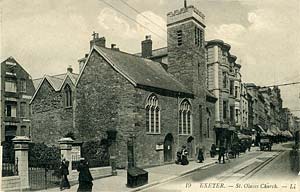
 St Olave's Church - Fore Street
Page updated 17th November 2010
This little church was founded as a house chapel by Gytha in 1053 so that prayer may be offered for her husband the Earl Godwin. Gytha was the mother of King Harold who was killed at the Battle of Hastings. It was dedicated to St Olaf, a Viking King who had accepted Christ and who died in a rebellion in 1030. When King William I entered Exeter after a siege, Gytha who was defending the city escaped with the help of the priest of St Olave's. William gave the church and surrounding land to the monks of Battle Abbey, who then established St Nicholas Priory nearby. The rector was vested in St Nicholas Priory until it was dissolved in 1536.
The church was rebuilt at the end of the 14th century, with the figure of the Scourging of Christ dating from this period. The mediaeval bell has the inscription, 'Voce mew viva depello cuncta nociva' or 'By my lively voice I disperse all that is harmful.' The north aisle was added in the 15th century and a new entrance cut by the tower, which has since been blocked in, and now has a memorial to the fallen of the First War, including Thomas Moore.
The church prospered until Cromwell had it closed, and it was used for a time as a school room. The arrival of Huguenots fleeing persecution from France from 1635 saw the church repaired and revived for their use. It was also recorded again as a school in 1744, and it also was a military chapel for the regiment that was currently quartered in Exeter.
In the early 19th century the coat of arms of William III were added as a centre piece to the altar, along with flanking panels of the Lord's Prayer and the Ten Commandments. Despite the inscription on its bell, it was tolled for the many victims of the cholera that swept the West Quarter in 1832. The church has survived for a thousand years and is still used, as one of the churches of the Parish of Central Exeter.
The War Memorial
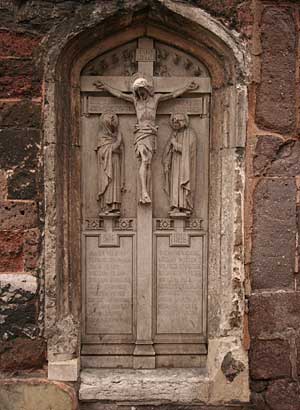
Dedicated on the 10th January 1917, this little memorial on the outside of the church, on Fore Street was the first war memorial for the Great War to be erected. The following appeared in the Express and Echo on the following day.
"WAR SHRINE DEDICATED AT ST. OLAVE'S CHURCH FIRST IN EXETER
The first war shrine to be erected in Exeter, and, it is believed the second in Devon, was dedicated at St. Olave's Church yesterday by the Lord Bishop of Crediton (Canon Trefusis).
The idea of providing a shrine originated with the respected rector of the parish, Rev. E. C. Long, who had seen many on the continent, and had been impressed by their usefulness to people who used them devotionally. His parishioners generously supported the project and a disused and blocked-up doorway in the south wall of the church, immediately abutting to the main street, provided a very convenient site. It is hoped to be able to erect a number of other shrines in the streets of the parish.
There are over a hundred names on the St. Olave Roll of Honour which is confined to parishioners who are worshippers at the church. Of these, eight have given their lives. The shrine itself is a beautiful piece of work. The old doorway is filled in with fumed English oak, heavily moulded round the ridge at the top. There is a full-length cross of wainscot oak, with Calvary steps, the whole surmounted with a piece of black English oak cut from a beam over 500 years old, and bearing an oxidised crucifix. "Pray for the men of St. Olave's" is the inscription in gold letters. A shelf is provided for flowers. The Roll of Honour is contained in two frames, one being for the fallen."
 The
memorial to the First War contains the name of Thomas Moore, the founder of the shop in Fore Street.
The
memorial to the First War contains the name of Thomas Moore, the founder of the shop in Fore Street.
│ Top of Page │