
 Join the Exeter Memories
 The 1917 Exeter tram crash
Page updated 27th February 2017
Back to historic events in Exeter
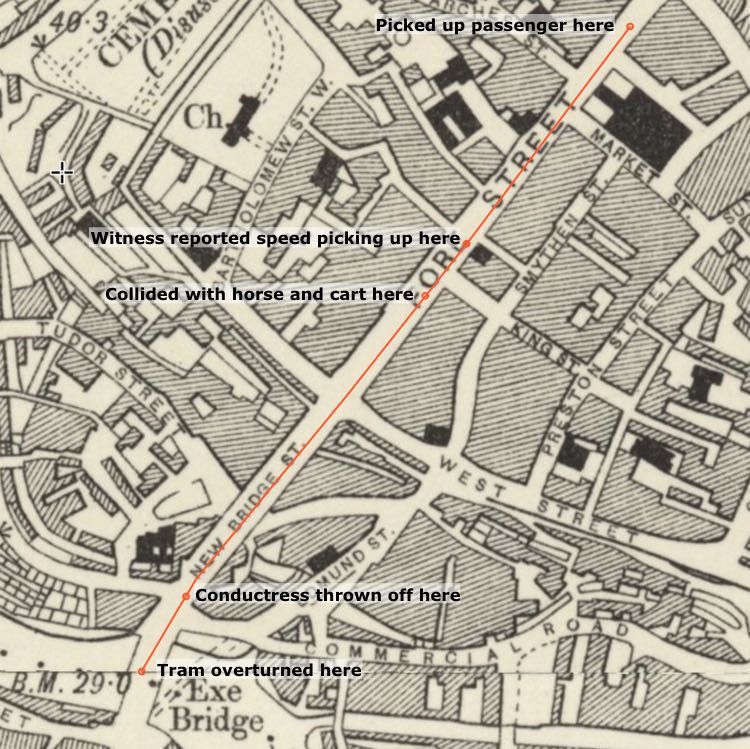 On 7th March 1917, the 11am tram from Heavitree to
Dunsford Hill encountered technical difficulties while ascending Paris
Street. The driver of car number 12, Mr Charles Saunders 42, managed to
restart the vehicle and continue.
On 7th March 1917, the 11am tram from Heavitree to
Dunsford Hill encountered technical difficulties while ascending Paris
Street. The driver of car number 12, Mr Charles Saunders 42, managed to
restart the vehicle and continue.
By the time it reached Milk Street (opposite British Home Stores) the tram had five passengers, four female and a 15 year old, Alfred Snow. As it started to descend the 1 in 11 gradient of Fore Street, the brakes appeared to fail, causing the tram to gather speed before colliding with a railway owned horse and cart, carrying tobacco and matches, that was passing a parked barrow, just below King Street. The horse and cart were swung round, pushing the horse into a shop front, and killing the horse.
The tram continued down the hill, narrowly missing a car coming up the street, at an increasing speed as the driver struggled to halt the speeding vehicle. The driver of an Exeter bound tram in Fore Street saw the runaway tram approaching his vehicle and managed to drive into the double tramlines before there was a collision. The conductress of car 12, Mrs Harle jumped off the tram in New Bridge Street by White Hall clothiers, rolled over, and escaped, suffering from cuts and shock.
When the tram hit the bridge, it left the rails, turned on its side, hit the parapet of the bridge, continued for a few yards and stopped. Two of the passengers also escaped, but two others and the driver were hospitalised.
Tragically the fifth passenger, Mrs Mary Findlay was found between the tracks, dead. A note written at the time said:
"I came along three minutes after it happened and it gave me such a turn, they was taking her body away on a st(r)echer she was squashed to atoms and they were washing away the blood".
Mrs Findlay's husband, a decorator, did not find out about her death until four hours later. Her grave is in the Higher Cemetery.
A large crowd gathered around the crash site, before the police arrived along with the chairman of the Tramways Committee and the situation could be dealt with.
The tram was badly damaged so it was hauled off to the tram shed on the Heavitree Road. It remained in the shed until 1921 when it was decided to scrap it as it was beyond economic repair.
The photographic studio of Henry Wykes overlooked the bridge at that time, so he was soon on the spot recording the accident with his camera. Within an hour he was selling postcards from his studio door of the disaster.
Charles Saunders, the driver was visited in hospital the next day by the Town Clerk H Lloyd-Parry and commended for his efforts to avert the tragedy.
The Inquest
The inquest was held in the Guildhall, when the Coroner interviewed witnesses of the possible cause of the accident. Walter Blacking who witnessed the tram hit the railway cart said that the collision caused the overhead trolley arm to lose contact with the power cable, and then the tram gained speed. John Robinson who was driving the railway cart saw nothing until the tram hit his cart.
An eyewitness described the collision with the horse and cart at the inquest.
Mrs. Ellen Friend, Beaufort-road, St. Thomas, was walking up Fore-street, and the car passed her just before the collision. In fact, she was at the time by Arnold's shop, the doorway of which the horse plunged and broke his neck. She said she saw the car first at King-street, and it was not then going faster than ordinarily. Just afterwards, however, it quickly gained speed, and immediately hit the waggon. She heard the tram driver shout to the carman, and she thought he had lost control as he did not ring his bell.
Herbert Percy Chant, a gas inspector, remembered that the driver was having difficulty when passing St John's Church, for he was pulling the brake handle hard. The tram then hit the rear load of the of the railway wagon, which was almost clear of the line. The driver then appeared to attempt to release the brake but the handle did not move. Chant estimated the maximum speed of the tram as 20 to 25 miles an hour.
Other witnesses described how two passengers jumped off at West Street, while William Back claimed that the driver shouted a warning to a woman with a pony and trap, who just managed to clear the line.
An eyewitness, Mrs Punchard was interviewed at the inquest and reported in the Western Times.
Mrs. Kate Punchard, St Thomas, was walking across Exe Bridge when the car was running down the hill. She saw a lady fall off the platform and roll over three times, but did not know then that this was the conductress. The trolley pole was swinging to and fro, and no one was on the drivers platform. She saw a man sitting inside, but she did not know whether this was the driver. This was by Bonhay-road. The man sitting inside had no uniform on–no uniform hat, and was waving his arms. She was near Hucklebridge’s shop, and she only spoke of what she saw when it passed her. She thought the final overthrow of the car was due to the fact that it could not mount the kerb
Another eyewitness thought the driver was at his place.
Albert Gillard said the car left the rails at the Exe Bridge. The dead lady was then thrown from the rear platform before the tram turned over on its left side and pitched onto the deceased. The tram then slid on its side until it reached the parapet and turned so the it pointed to St Thomas before stopping. One witness claimed that the dazed driver said after the accident, "I told them the car was not exactly right when we took it on."
The verdict was accidental death.
Sources - Western Times, Exeter and Plymouth Gazette, Express and Echo and Trewman's Exeter Flying Post. Quote from Exeter Postcards by John & Margaret Folkes (Tempus Publishing)
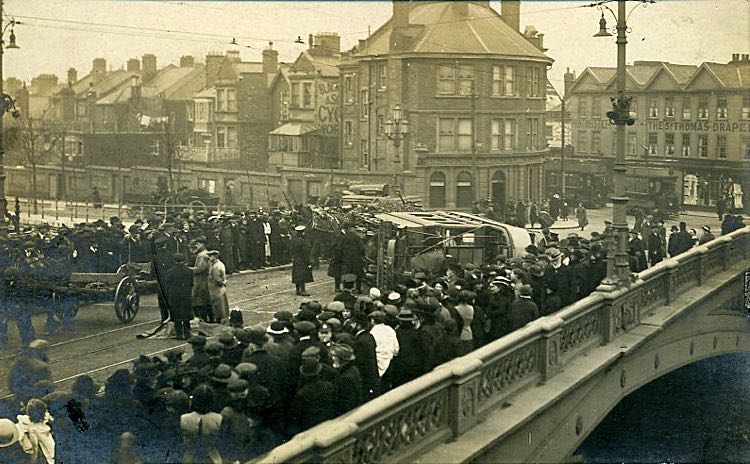
MA large crowd gathered around the overturned tram.
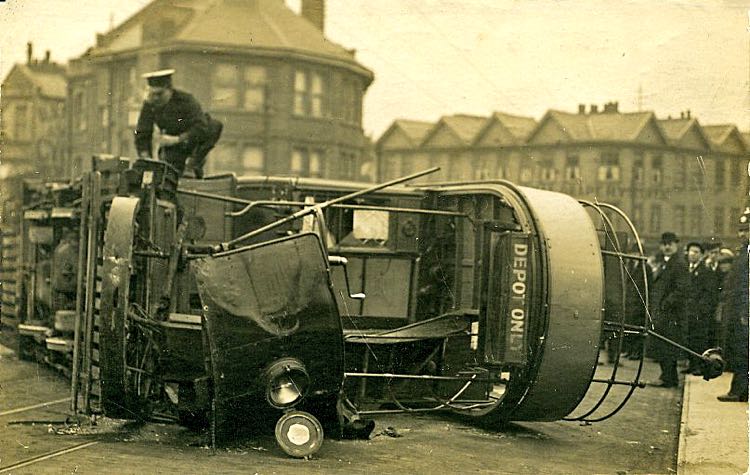
A closer view of the tram on its side.
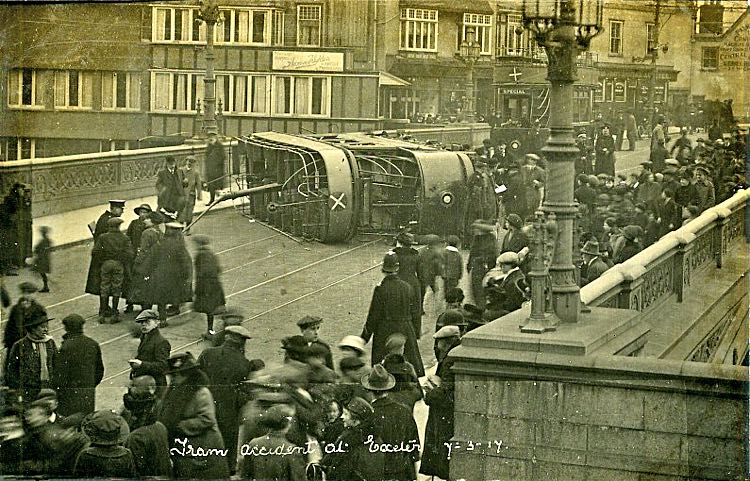
A postcard produced by Mr S A Chandler of the crash.
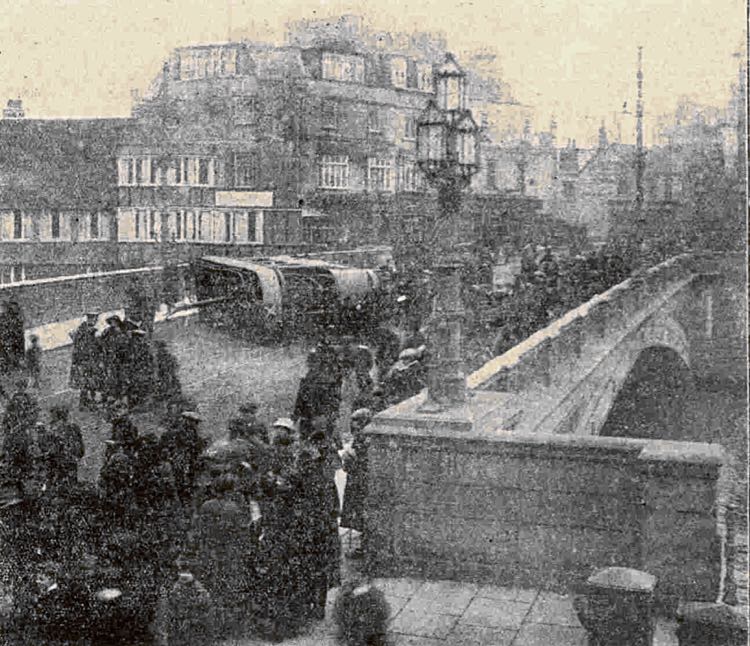
The newspaper version of the Chandler photograph, left.
│ Top of Page │