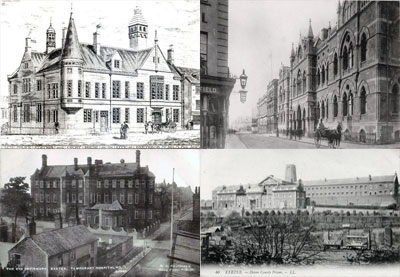
Early Banks of Exeter *
Butts Ferry
Cinemas*
Devon & Exeter Institution
Devon and Dorset Regiment *
Exeter City Police history * NEW
Hospitals *
HMS Exeter *
Maritime Museum *
Mayors - history and list *
Phoenix Arts Centre *
Prisons, Bridewell and Debtors *
Royal Albert Memorial Museum *
Sports Clubs and Centres *
Theatres *
University *
note - * links are separate pages
this popular ferry that runs in the summer costs
the princely sum of 20 pence (2004). It is human powered with the
ferryman pulling the ferry along a cable stretched across the river.
When a large boat wants to pass, the cable is lowered into the water.
It saves a walk from the quay to Shooting Marsh Stile and the Canal
Basin over the Cricklepit Suspension Bridge, designed by Dave Hubbard
and which was opened on 29th June, 1988. On the Exeter side of the
river is a range of small businesses installed in the arches under the
sandstone cliff.
The ferry was not devised for tourists but was first run in 1641 or
even before, tended by a succession of local families. In January 1973,
the ferry was threatened with closure when the City Council, who had a
statutory duty to run the ferry, tried to relinquish it. Mr George
Butt, an insurance broker, fought to keep the service with a petition
signed by 66 residents and 2,500 visitors - a seven hour public
inquiry ruled that the ferry be retained.
On each side of the river at this point, is a lamp standard that
was
taken from the six that were located on the 1905 Exe bridge. They were
cast by Macfarlanes of Glasgow. The lamp standards were removed from
the old Exe Bridge in 1973, and these two painted in the city's
official colours and installed on the quayside in 1983.

The
modern Butts Ferry in 2005.

Butts
Ferry before 1973.
│ Top of Page │
Founded in 1813, the Devon & Exeter Institution occupies a building that can trace its heritage back to well before the 16th Century.
Originally built to house cathedral clergy, the building was remodelled in the 16th Century. The Parliamentary General, Sir William Waller as a young man travelled to the continent as an English volunteer. He was knighted in 1622 for his foreign adventures, and married Jane Reynell, the daughter of a Devonshire family. The couple made this building their home. In 1662, the Courtenays, a name long associated with Exeter, acquired the building as their town house. It remained in the Courtenay's possession until the Devon and Exeter Institution was formed in 1813, and occupied the house as their base.
When the Institution first occupied the property it consisted of the house with a hall and kitchen surrounding a large courtyard. The rooms for the library were built in the courtyard - they have a gallery ringing each room and are naturally lit from above. The front of the building was given a Georgian makeover.
The aim of the institution was to promote the arts and sciences in the west country, and provide a meeting place for gentlemen to meet and discuss both local affairs and affairs of state. It is still running and its library is an important reference for books and historic newspapers from Exeter and the south west.

The Devon and
Exeter Institution in Cathedral Close.
│ Top of Page │