
 Join the Exeter Memories
 City of Exeter Lunatic Asylum
Page updated 8th November 2017
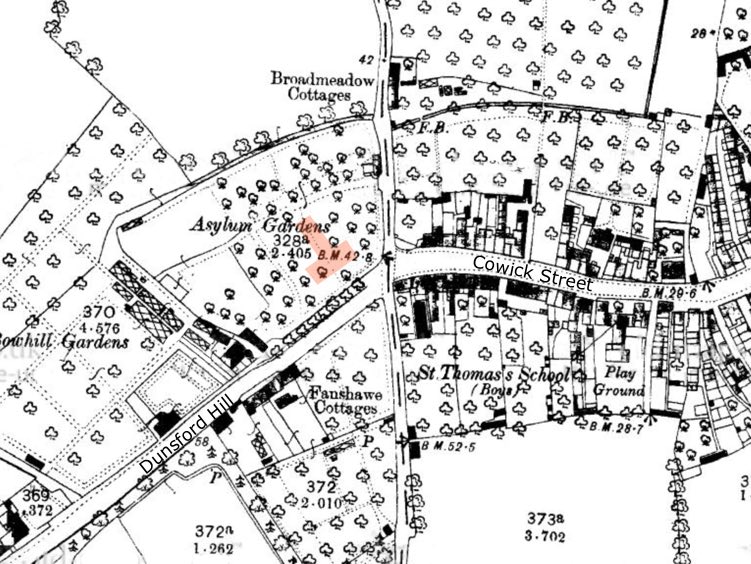 The foundation of what was in effect, Exeter's first mental hospital was proposed "at a meeting of the grand jury, held at the Castle of Exeter the 16th day of March, 1795, Sir Bouche Wrey, Bart., foreman of the chair." A bequest from a Mr Pitfield of £200 was made, to build a lunatic ward at the Devon and Exeter Hospital. The bequest was for a facility for middle-class and professional patients, who would not be funded by the rates.
The same year, Bishop Buller found an additional £200 to be donated to the Devon and Exeter Hospital. It was suggested by the Rev. James Manning that the money be combined with the Pitfield bequest to construct a purpose designed building to care for the city's lunatics. Lower Bowhill House, adjacent to the turnpike house at the bottom of Dunsford Hill was selected for use as the hospital, and was opened on 1st July 1801. This site is not to be confused with Bowhill House, further up the hill.
The new building
Plans were made for a newly built facility, next to the existing house, and on 23rd March 1803, the foundation stone was laid by the Rev Manning. Accommodation for seventy patients was provided, which included three walled courts and three gardens, along with five indoor galleries. The constitution stated, contrary to the current opinion at that time that such cases were hopeless, that the inmates were to be cured of their symptoms.
A select committee in July 1817 considered the provision of religion in the nations asylums. Robert Seymour Conway wrote to the asylum, "enquiring about religious provision; and was told that the only real religious instruction was received at the parish church, which only the apothecary, matron, servants in rotation and a few patients went to."
The rules for the asylum may seem peculiar to modern eyes, but for the time, they were enlightened. Some rules were quoted in an article in the Western Times in 1878:
No patient shall be chained or handcuffed without the previous knowledge and approbation of the physician or apothecary.
The physician and apothecary shall visit the asylum every Tuesday morning at twelve of clock, and oftener when any urgent case shall require peculiar care and attention.
That the feet of every patient under confinement or in straw shall be carefully examined and rubbed and covered with flannel every night and morning during the winter months.
Although opened for the middle classes who were expected to pay, pauper inmates could be given a place in the hospital if accompanied by an order from a Justice or Clergy and an officer of the parish from where the came. From 1812, Dr John Blackall was the resident physician, who was replaced by Dr Thomas Shapter in 1845. The 1842 Metropolitan Commission in Lunacy reported that the hospital needed more land, and plans were made to build a new institution in Wonford. The hospital closed when Wonford House Asylum (now Exe Vale Hospital) opened in 1869.
The site of the asylum became the John Stocker School; in the 2000s, Bowhill Primary School was constructed, with playground and games pitch overlaying the old asylum building.
Source: Research by Julia Sharp, Stuart Blaylock's Bowhill The Archaeological Study of a Building Under Repair in Exeter and Peter Thomas' Aspects of Exeter.
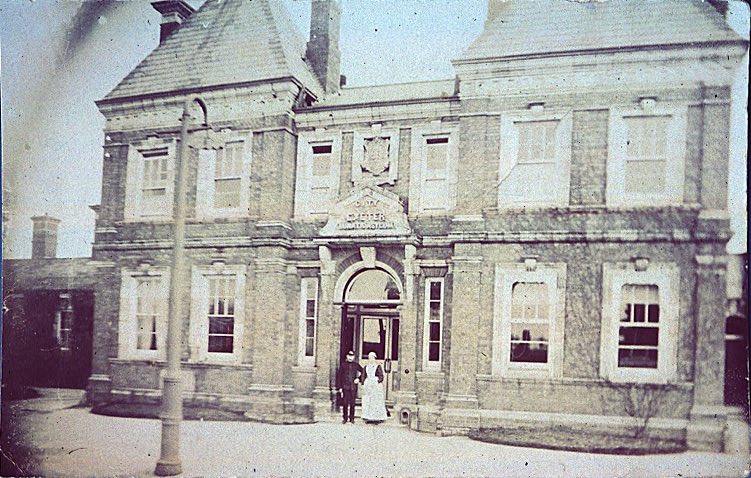
This photo dates from before 1868, when the asylum closed.
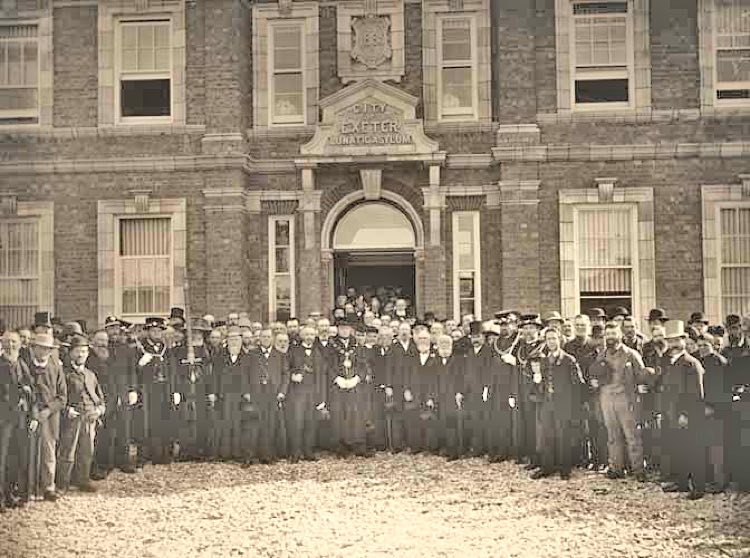
This group photo outside the front of the building was possibly taken when it closed in 1868.
│ Top of Page │