
 Join the Exeter Memories
 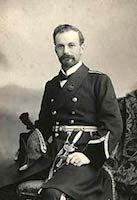 Frederick John Widgery – artist and Mayor
Page updated 14th February 2018
Return to Exeter People Menu
The son of William Widgery, who had made a name for
himself as a self taught artist, Frederick John Widgery not only became
an artist of some repute, but he became a prominent and active
councillor and Mayor of Exeter. Born in May 1861, he attended the
Exeter Cathedral School where he showed his father's aptitude for art.
He went on to the Exeter School of Art and then the South Kensington
Museum School before travelling to Antwerp to study under Charles
Verlat at the National Art School. Upon his return to England, Widgery
studied at Professor Hubert von Herkomer's School at Bushey in
Hertfordshire.
Now, with a thorough grounding in painting, he
started his career in London in 1889, only to
return to Exeter in 1890, to
make his way as an artist. Widgery purchased 11 Howell Road from his father, and lived there for 49 years. He established
his studio at 20a Queen Street (now Whitton and Laing), close to the modern entrance to Habitat
opposite the, by now, flourishing Royal Albert Memorial Museum which
incorporated the School of Art.
Widgery soon became involved in many local institutions including the Rotary Club, and as a member of the 1st Devon and Somerset Royal Engineer Volunteers he rose to Captain. He was first elected to the city council in 1898, and after just 5 years, was unanimously elected mayor in November 1903. This was an exciting time for the city, with the planning and construction of a new bridge over the Exe, and new electricity generating station to power a new electric tram system. The adoption of FJ as the city's motor car registration letters, which Frederick John was never slow to point out, was always thought to be in homage to Widgery, but it was alas, a coincidence which has acquired the status of popular myth.
Civic honours awarded to him included Honorary Freeman of Exeter 1905, Alderman 1909, and Justice of the Peace in 1912.
After his year as Mayor, he was made a Freeman of the City on 11th March 1905, and an Alderman in 1909. He was chairman of the Town Planning Committee until 1938, and as such, was instrumental in many of the initiatives that were taken in town planning, including inviting the Cities and Town Planning Exhibition to Exeter in 1911. One of the outcomes was the formation of the Exeter Pictorial Record Society, also in 1911, to record and preserve a pictorial record of the city as it underwent modernisation. Among the many photographs and other images of the city, are a set of drawings presented by Widgery to the Society. He became Chairman of the Board of Governors of the Royal Albert Memorial College and served as Chairman of both the College Committee and Fine Arts Committee. In 1931, he donated his entire collection of sketches and sketchbooks to the museum.
As a painter, Widgery enjoyed considerable success,
and is best
remembered for his watercolours of Dartmoor, Exmoor and the Devon
coastline.
Widgery supplied the Samuel Coombs Gallery in London with many gouche
watercolours. His reputation spread to America, Australia and other
places overseas,
and even now, there is a healthy trade for his paintings. He had six
paintings exhibited at the Royal Institute of Oil Painters, five at the
Royal Academy and three at the Walker Art Gallery in Liverpool. A
watercolour of Dartmoor, painted in 1925 was used by the GWR as a
poster entitled, 'Glorious Devon'.
After a full life devoted to painting and public service, F J Widgery spent his last months in a nursing home, and died on 27th January 1942 at the age of 81.
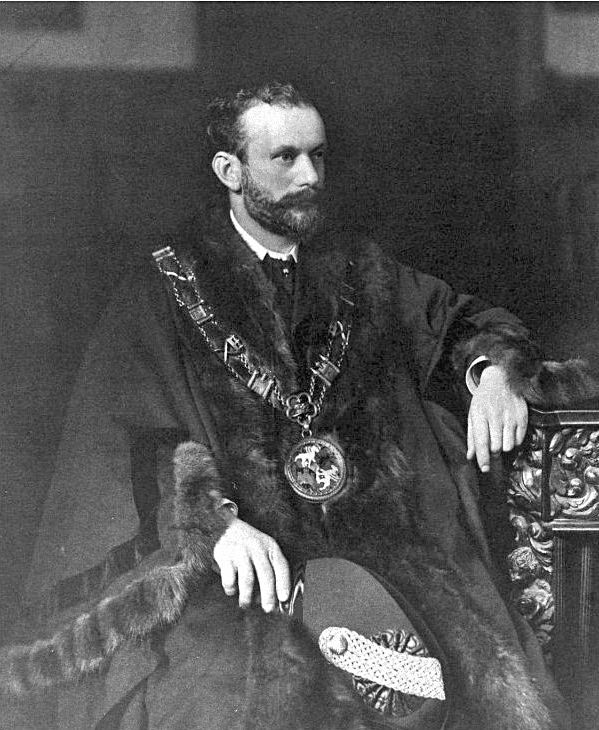
Councillor F J Widgery in his Mayoral garbs in 1904.

Widgery laying the foundation stone for the new Exe Bridge on 23 July 1904.

A typical Widgery watercolour of his beloved Dartmoor.

A Widgery painting used as a GWR poster in 1925.
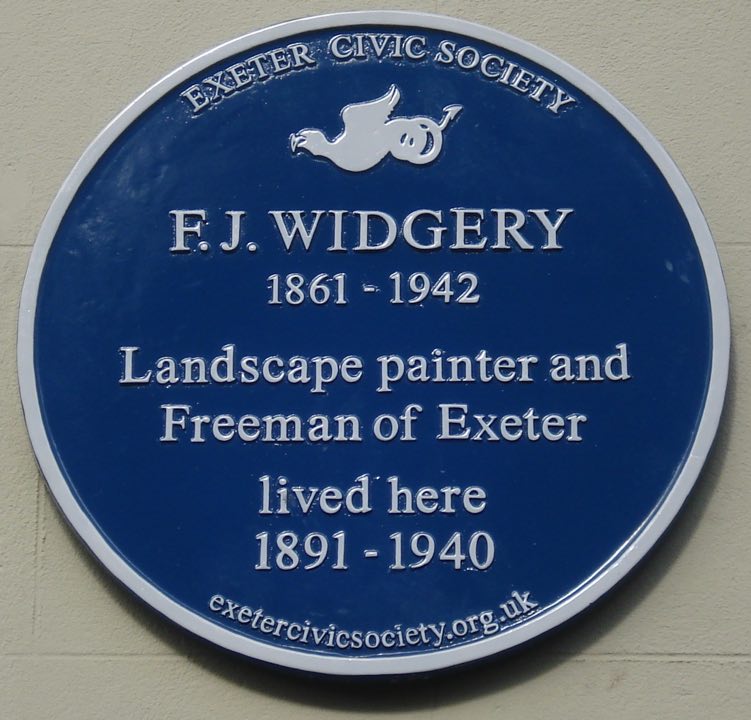
A plaque commemorating Widgery in Queen Street, placed there by the Exeter Civic Society.

Widgery's modest grave, along with his wife, in Exwick Cemetery.
│ Top of Page │