
 Join the Exeter Memories
 Bude Hotel - aka Bude Haven Hotel, Old London Inn, London Inn
Page updated 11th February 2019
 This almost forgotten hotel in Sidwell Street was
once one of the most important coaching inns in Exeter. It was a rival
to both the New London Inn and the
Royal Clarence Hotel.
This almost forgotten hotel in Sidwell Street was
once one of the most important coaching inns in Exeter. It was a rival
to both the New London Inn and the
Royal Clarence Hotel.
Situated in Sidwell Street and sandwiched between the junction of Paris Street and Southernhay, directly opposite Debenham, the Bude Hotel was established in 1358. The Courtenay's owned properties and land around Exeter, causing problems between the city and the family. They owned the Londonsyn, which may have been on the site of the Bude Hotel. What is known is that it was known as the London Inn during the 17th and 18th Century. In 1668 the site was considered for a new workhouse for the city, but eventually, it was located at the bottom of Paris Street, near the
As the fortunes of some of the old inns of Exeter waned, the London Inn began to prosper, largely due to the introduction of the turnpikes, and the increase in travel by coach. The London Inn extended to the rear with space for stabling and other facilities. The Duke of York changed horses there in 1763 when Isaac Moneypenny was running the place. He had recently introduced a London coach service from the inn that took two days - a fast time then. In 1788 the Prince of Wales, the future George IV, dined at the inn, adding to its good name.
In 1772, Thomas Pratt of the Half Moon moved to the London Inn. His family would be linked for many years with Exeter's hotels. Under Pratt's tenure the the "Favorite" Subscription coach called at the hotel on its journey from Plymouth to London, while in 1850 a mail service left the hotel at 4am every day of the week, for Bude via Stratton and Holsworthy. Pratt died in 1789, leaving the inn to his widow. It was when the New London Inn was opened by John Land in 1790 that it was renamed the Old London Inn to avoid confusion. The Pratt family ran the inn until after 1844–in 1850, Joseph Pratt had transferred to run the New London Inn.
It was around about 1848 that it was renamed the Bude Haven Hotel and then the Bude Hotel around about 1878. In 1837 it had stabling for 67 horses, with extra capacity in Longbrook Street. The introduction of the railway saw changes in the hotel trade, and the Bude Haven was remodelled for the last time.
In the 1920's it was put up for auction twice, and twice failed to find a buyer. The amount of traffic crossing in front of the hotel increased after the First War and the junction was proving to be a bottleneck - the City Council stepped in and purchased the Bude Hotel in 1933. The last round of drinks in the bar were purchased by a city councillor and it closed in 1933 to be demolished to widen the road. The rear part was purchased by a small local grocery firm called Fearis (Ferris). They opened a restaurant in their store named the Bude Grill, but it was lost in the 1942 bombing.
After the war, the Bude Lounge opened as a subterranean bar at 106 Paris Street according to one contact, who was police officer at the time. I can't find a listing in the 1956 Kellys, so more research is required.
Source: Robert Dymonds Old Inns and Taverns of Exeter, the Express and Echo and trade directories. © 2006 David Cornforth - not to be used without permission
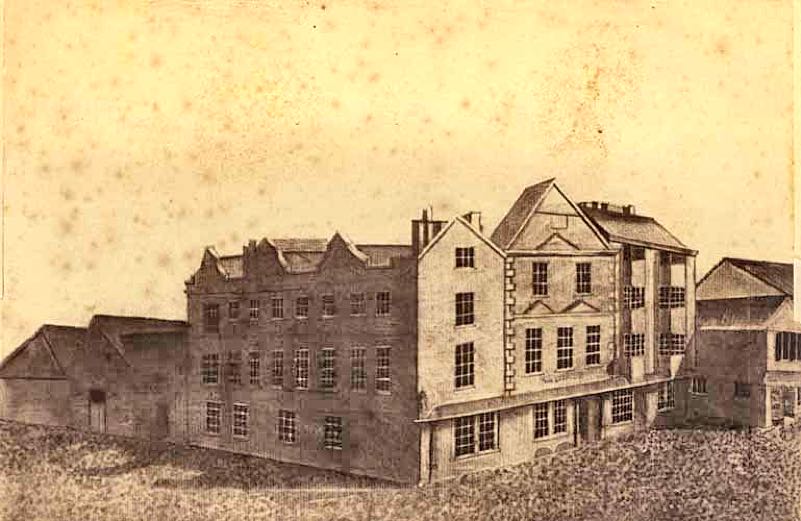
The London Inn before it was renamed.

The Bude Hotel, probably before the First War. Notce that they were offering a garge for the newly introduced motor car.
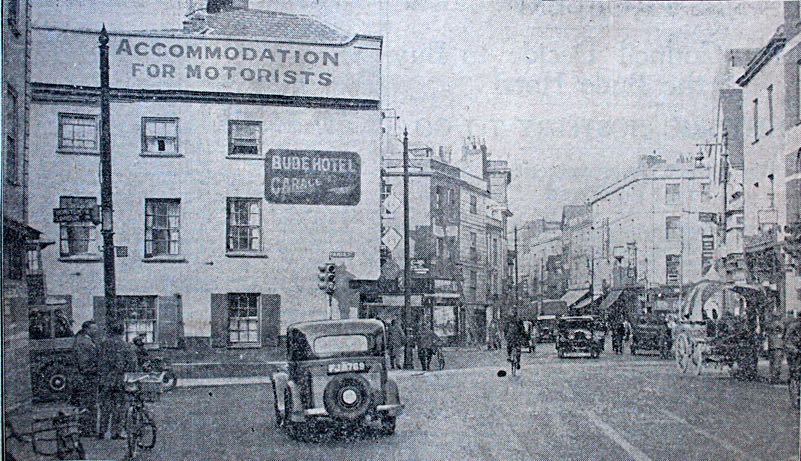
A news photo from 1933 was taken just before the building was demolished for road widening.

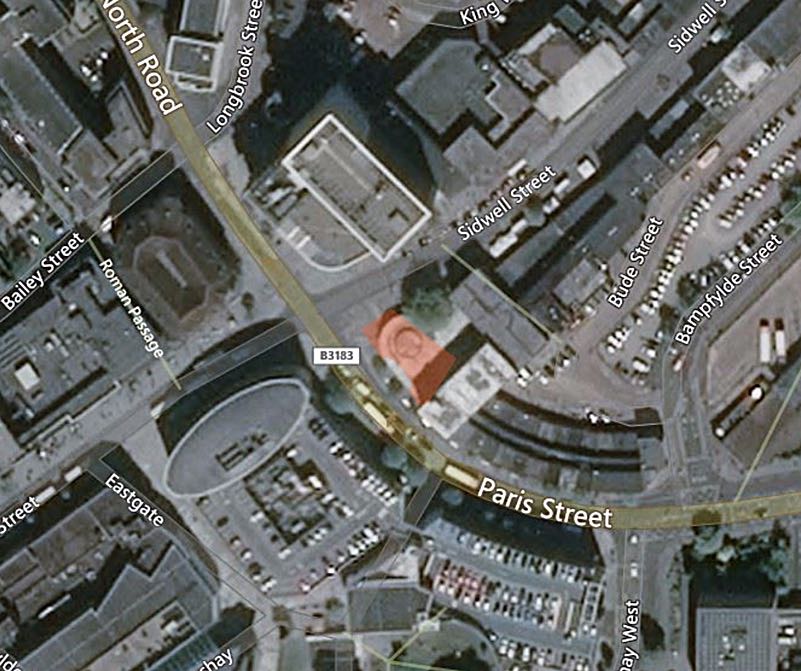
The footprint of the hotel on a modern map.
│ Top of Page │