
 Join the Exeter Memories
  The
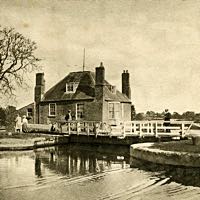
Double Locks Hotel
The
Double Locks Hotel
Page updated 25th February 2018
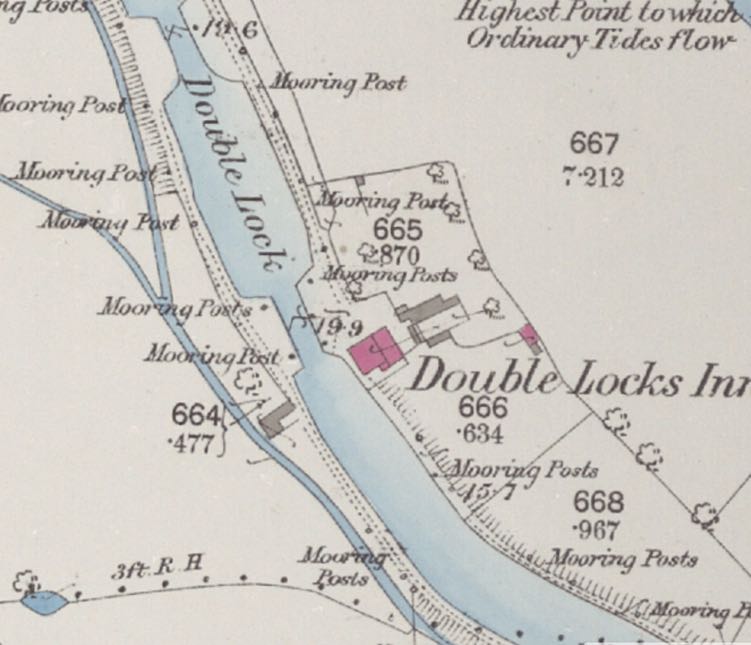 The Double Locks is a
very popular inn for a lazy sunny
afternoon or a tasty meal, attracting students and families alike in
the summer months. Built in 1701, as a
lock keepers cottage, at the time of great
improvements to Trew's original canal, it doubled as both a lock
keepers house and inn from the late eighteenth century. It was built of
small
Dutch bricks which were imported as ballast when Exeter was exporting
serge to Holland. In the next expansion of
the canal in the 1820's, James Green who
built the canal basin, rebuilt the Double Locks, reusing some of the
earlier bricks along with more modern, locally made bricks. A tow
path
was added to each side of the canal at
this time to allow larger ships to be towed by horses and one of the
Double Locks functions was to provide stabling for the horses.
The Double Locks is a
very popular inn for a lazy sunny
afternoon or a tasty meal, attracting students and families alike in
the summer months. Built in 1701, as a
lock keepers cottage, at the time of great
improvements to Trew's original canal, it doubled as both a lock
keepers house and inn from the late eighteenth century. It was built of
small
Dutch bricks which were imported as ballast when Exeter was exporting
serge to Holland. In the next expansion of
the canal in the 1820's, James Green who
built the canal basin, rebuilt the Double Locks, reusing some of the
earlier bricks along with more modern, locally made bricks. A tow
path
was added to each side of the canal at
this time to allow larger ships to be towed by horses and one of the
Double Locks functions was to provide stabling for the horses.
A strange little story appeared in the 1 June 1825
issue of Trewman's Exeter Flying Post. The body of a man was found
drowned in the canal. A rumour appeared
in the local newspapers, that the lock keeper had refused to allow the
body to be placed in his house. The Flying Post printed a statement,
acquitting the landlord of the slur and
giving the true story. The landlord, Mr Perryman was not at home at the
time of the incident and the body was conveyed to the House of
Reception at the Exeter Lime Kilns. The
article clears his wife "....and
exculpates
Mrs. Perryman (who was much hurried) from the slightest imputation of
inhumanity or neglect."
Although a working canal, the tow path attracted locals on a Sunday for a stroll, and the Double Locks catered for these walkers. James Cossin wrote that as early as the 1830s, the inn was a popular destination.
Of the walks on the other side of the Exe, from Haven Banks to the Double Locks was the most frequented, from its pretty scenery and refreshing air, being about two miles by the side of the canal. The majority out of the many hundreds were mostly the younger members of the community. At the quay about fifteen to twenty vessels might be seen, and beyond were boats moving to and fro, the double locks being the extent of the pull. The inn was the rendezvous for refreshment, and was well patronised, every room, the skittle alley, and forms in the field being engaged by the weary ones.
In August 1852 a terrific thunderstorm hit the city and a man was killed at the Double Locks. The London Times reported
"During the storm, a house, called Double Lock, on the banks of the Exeter Canal, was struck by the lightning. Some persons who were standing in the passage, at the back of the house, were struck by the electric fluid, and one of them, a gentleman named Burnham, was killed on the spot. He was struck on the head and died instantly. Two young men standing near the deceased were struck down, and their limbs, especially the lower extremeties, are paralyzed. Two persons were standing at the door of the passage where the catastrophe occurred, and it is a singular fact that the lightning passed over them, leaving them perfectly unhurt, and struck the group within the passage."
Melting heavy snow in January 1918 brough floods to Exeter, as the Exe became swollen with flood water. In combination with a high spring tide, low lying ground along the river banks became flooded. The fields lying between the river and the canal, and the Alphington side of the Canal as far as Turf were badly hit. Mr. C. J. Hannaford, of the Double Locks, said the flood was the highest he remembered.
Roland Hugh Tuson, who lived during the 1920s near the Welcome Inn remembered as a boy:
On the warm, long evenings young men and their ladies would flock down to the river to hire a boat and row down to The Double Locks and after a drink or two start to row back. After a while many pulled in to the side and wandered off into the fields to continue their courting. We would wait at the Double Locks until most of the couples had left and then slowly walk back along the tow path. When we spotted an abandoned boat we jumped aboard and then row it back, picking up any other boats that had been left. On returning them we were rewarded, usually about a half penny a boat very quickly spent in the nearest sweet shop on Haven Road.
The lock keeper in October 1939, found a female human leg in a brown parcel when out patrolling his area. A search by two police officers revealed a second leg from a bed of reeds, also in a brown parcel. The police sent divers into the canal looking for a body, but none was ever found. Although there were five missing people from Exeter, two of whom were women, the police decided that a medical student had disposed of the legs.
George Hutchings, who was the lock keeper in the 1950s, was formerly in the Royal Engineers in the Second War. On 30th November 1963, he watched the All Blacks beat the South West Counties 38-6 at the County Ground, with some old wartime friends. After, they went to a pub before he was offered a lift back to the Double Locks. The wife of one of the men alerted the police at 5am the next day, that her husband had not returned home. The police searched and discovered skid and tyre marks on the canal bank. The water was 20 ft deep and murky, so two members of the John Webber Sub Aqua Club were called to dive the canal. They discovered the car with the bodies of the three men – a crane belonging to Exeter City Council hauled the car out and the bodies taken to the mortuary. The other two victims of the accident were Albert Edward Barrett and Cyril Seldon.
The Locks
The locks themselves, are the longest in the
country, at 95 am long by 8 am wide and can fit two ships at once - hence
'the double locks'. When the York Class
Cruiser, HMS Exeter was refitted in 1938, the old masts were removed
and used as the arms on the lock gates. In April 1956, a quote from Messes R W & F C Sharp for two pitch pine balance beams measuring 14x14inch by 45/46ft at 32/11 (£1 12s 11d) per cu.ft delivered to Exeter Station was accepted.
Getting to the Double Locks can be a problem–drivers can take the
road through Marsh Barton, go over the narrow railway bridge, cross the
Salmon Pool swing bridge and follow the
narrow road along the canal to the hotel. In former times, before
breathalyzers, returning revellers have ended up in the canal - even
those without a car! Mind you, a visit on a
bicycle or by foot on a hot sunny afternoon is very pleasant,
otherwise, take a non-drinking driver. It was CAMRA's best pub in the
south west in 1990.
Sources: City Council Navigation Committee minutes, Express & Echo. The British Newspaper Archive. Memories of Roland Hugh Tuson. Reminiscences Fifty Years Since by James Cossins
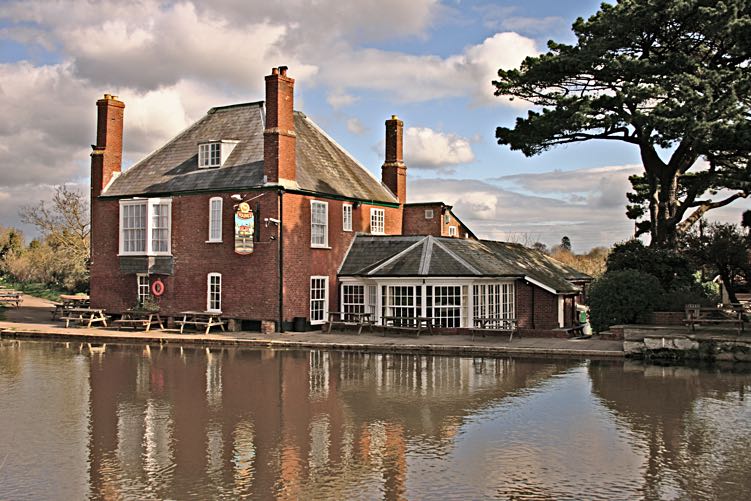
The Double Locks in 2005. Photo David Cornforth
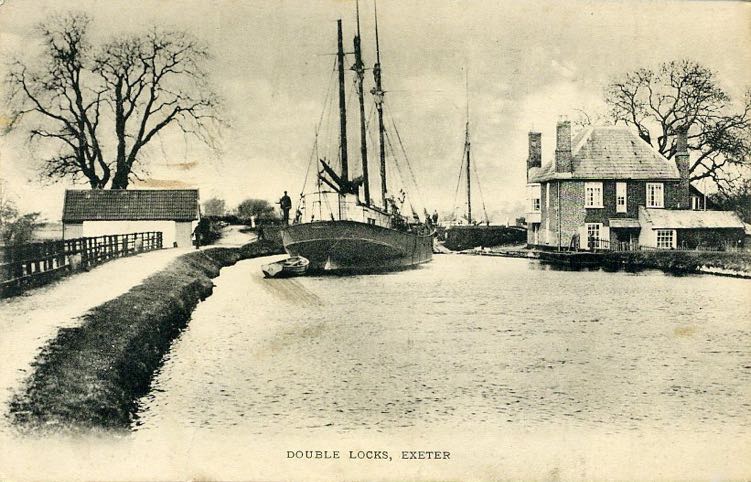
A three master is pulled through the lower gate by a horse before the First War.
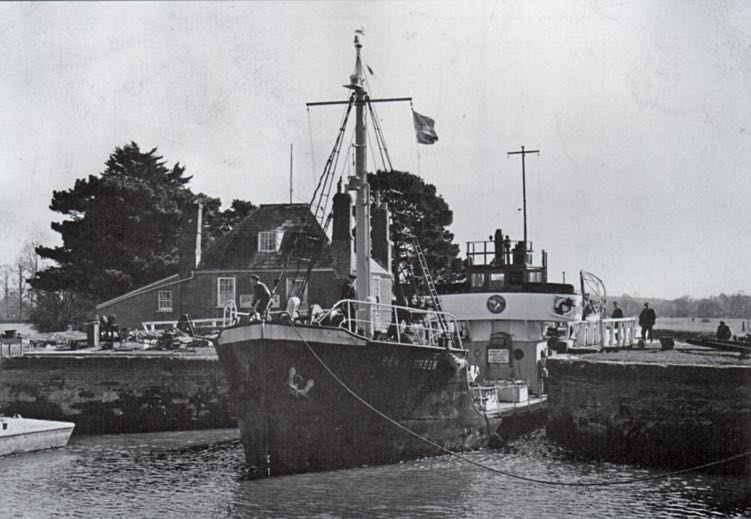
The Ben Johnson traverses the lower lock, bound for the city basin in 1955.
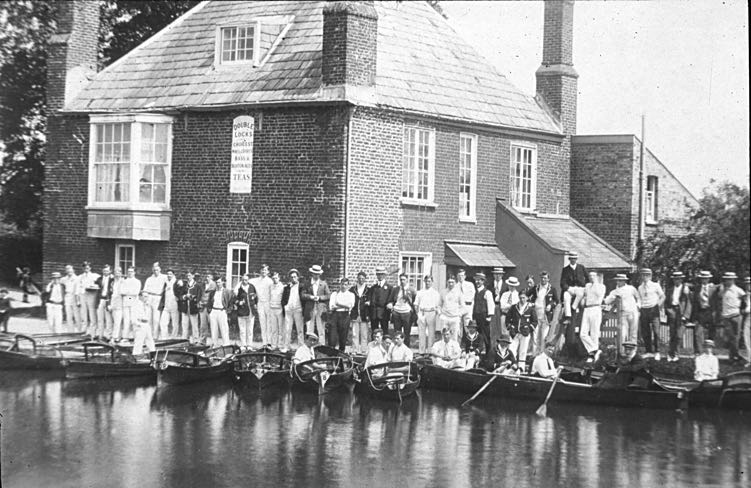
An outing, possibly of the rowing club, stop off for refreshments at the Locks, in Edwardian times.

The upper gates.
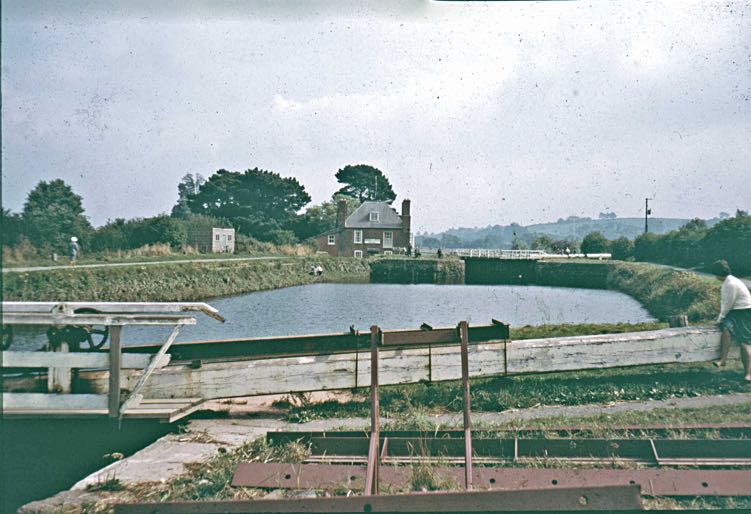
An arm for working the lock gates in the 1970's. Last two photos courtesy of Alan H Mazonovicz
Some trade directory listings and Flying Post entries for the
Double Locks are:
1791- this appeared in Trewman's Exeter
Flying Post on 12 May 1791.
"Saturday died, in an advanced age Mr John Hayward, Keeper of the Double Lock"
1825 - Thos. Perryman, Keeper of the Double Locks - Flying Post
1850 - Double Locks Inn, Thomas Pennyman - possible misprint, White's
1878 - Double Locks, William Pearce - White's (he had previously run the Turf Locks)
1897 - Double Lock inn, W. C. Hannaford, Alphington, Exeter - Kelly's
1906 - Double Locks, Hannaford W. C., Haven road, St Thomas - Besley's
1923 - Double Locks - William Carter Shillabeer Hannaford - Post Office
1934 - Double Locks, Lamprey, C. W., Haven banks - Besley's
1939/1947 - Double Locks, John Frederick Baker
1956 - Double Locks, Geo. H. Hutchings, Canal Banks - Kelly's
1967 - Double Locks Inn, Canal Banks - Kelly's
│ Top of Page │