
 Join the Exeter Memories
 The Rougemont Hotel, Queen Street
Page updated 14th December 2016
This very prominent hotel is situated in Queens Street, opposite the Central Station. In 1818, a House of Corrections or Exeter Borough Prison was built on the site to replace the old Southgate Prison in the old South Gate. Until quite recently there were shackles in the cellar that had survived from the prison. The prisoners were moved to Devon County Gaol in September 1863 and the prison closed.
The Devon and Exeter Hotel Company commenced construction of a 28,859 square foot, a hundred bedroom hotel with the demolition of the old prison, while temporarily retaining the walls—the foundation stone was laid in April 1877 and construction of brick with white Beer and Bath stone dressings commenced. In May 1878, John Howard of Coombe Street, a worker on the construction fell from some scaffolding and was thought to have been killed. Two days later, the Western Times reported that he was alive and progressing in hospital.
Work was progressing well, for two weeks after the accident, the builders were advertising for ten plasterers. In September, the provisional manager, Mr Edwin Fewings was applying for a licence with a view to opening in February 1879.
Progress slipped on the construction, but by 18th March 1879, the Mayor and other magistrates visited the almost completed hotel with a view to granting it a licence. They were shown the new electrical apparatus for ringing a bell to summon a member of staff—it was claimed there were eight miles of wire in the hotel for the device. They also inspected the billiard room, said to be the largest in the west of England, and the smoking rooms, obviously a priority for the city officials.
Completion
The main, ground floor entrance hall is 60 ft (18 metres) long, 20 ft (6 metres) wide and 30 ft (9 metres) high. The first floor is supported on Doric columns while the second floor is over Corinthian columns. The coffee room on opening was 60 ft long, again, with four Doric columns supporting the box girders of the panelled ceiling.
The hotel was designed by Mr Charles Edwin Ware AICE of Exeter and constructed by Mr James Matcham of Plymouth. Mr E Whipple of Plymouth supplied the bell apparatus and gas-fittings, and the lifts were from Waygood and Co., of Leeds. Local firm, Garton and King, fitted out the kitchen, in the basement, with two ranges, and also fit out the laundry and drying room. It seems that the company were lavish with their requirements, and there probably was not another hotel in Exeter that had the same level of equipment at the time.
At completion, the hotel had cost £21,000, plus £5,000 for fittings, and £6,000 for furnishings. A grand dinner was given at the opening in May 1879.
The building was only the first phase of a planned, much larger hotel. There was to be another wing to the left of the main hotel and a further wing on the right, complete with a circular tower, making the existing main building the centre of a hotel spreading along Queens Street. In addition, the owners had plans to purchase the land that became Queen’s Street Station and turn it into a park with a fountain, giving the patrons of the hotel a pleasant view and an area to walk.
In 1940, the hotel opened the Drake and the Golden Hind bars, to celebrate Exeter's association with naval history and Sir Francis Drake. There is also a stained glass window of interest at the top of the central staircase. Designed by Mr Frederick Drake, it shows an incident when Richard III visited the city and was shown around Rougemont Castle - the inscription reads, "....a bard of Ireland told me once I should not live long after I saw Richmond". Richard had confused Rougemont and Richmond. The window was removed to the cellar for safety during the war.
The conference rooms are all named after the Duke of Devonshire's family and estate—Devonshire, Hartington, Burlington, Chatsworth, Cavendish, Derby and Compton. There is also a series of paintings of the Devon countryside by W Widgery in the Cavendish Room - although not valuable, they are considered an important part of its heritage.
Opening
On 27th May 1879, the hotel held its first property auction, a sign that it was well and truly open for business. They were soon playing host to many conferences, a source of valuable revenue, and within the first few months, the Western Counties Dental Association held their annual meeting in the function rooms, and the British Medical Association held a dinner.
In 1877 a ball-room was added to the facilities, and on the 10th January 1888, the first ball was held for 420 county families. Up until the First World War, the Annual Christmas Ball became a highpoint for society.
During the war years, between 1914 and 1918, the hotel was used for many functions to help those affected by the war, or for fund raising. Madame Adele Vilas Hoare also held her popular dance classes through these austere times.
Saved from the fire
In 1919 the neighbouring Victoria Hall, caught fire and burnt down. The heat from the fire broke every window and seared the painted surfaces in the window sashes in the side of the hotel that faced the blaze. The fire crews had to direct water jets at the eaves of the roof to prevent it catching fire. Guests, including a Times reporter, made sure the hotal was evacuated and leant a hand to the staff in dealing with the emergency.
Although the Rougemont never suffered a hit during the May 1942 bombing raid, it is curious, that the only photograph taken of the city that night, was taken from the top floor of the hotel. It shows against a black night sky, the Cathedral and St Mary Major Church with huge clouds of smoke illuminated by the flames.
Although rooms in the hotel were commissioned for the use of businesses that had been bombed out, most mentions of the Rougemont in the newspapers of the times adverts, as news events were censored.
Room 202
An incident from 1981 created a small stir at the
hotel. A 16 year old youth who had run away from home, in Berkshire,
checked into Room 202. A waiter, when called to his room, was
threatened. The youth had in his room a sporting crossbow, 18 x 1ft
long
bolts, 2 daggers, a dummy hand grenade and a smoke canister. Twenty
police, some armed were called and they
laid siege to the room for a period of 4 hours before the boy gave
himself up, without a struggle.
The hotel's name was changed to 'The Thistle Hotel' a few years
ago, the
sign of the then, new, corporate owners, but it reverted back to the
Rougemont Hotel in May 2008. The Mercure Group were the next to acquire the hotel, when it became the wordy Exeter Mercure Rougemont Hotel–hardly trips off the tongue. These corporations have no idea...
Sources - A History of the Rougemont supplied by Thistle Hotels, the Express and Echo, Western Times and Exeter and Plymouth Gazette, Exeter City Guides and Exeter Burning by Peter Thomas, the Illustrated Carpenter and Builder 25 April 1879.
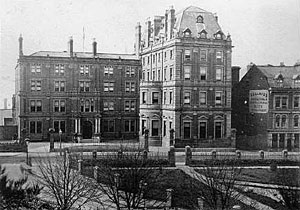 The Rougemont Hotel, circa 1880. The area opposite, that is now Central
Station, was a park until the 1930's.
The Rougemont Hotel, circa 1880. The area opposite, that is now Central
Station, was a park until the 1930's.
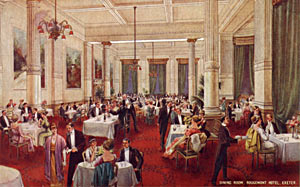 The Rougemont dining room before 1918.
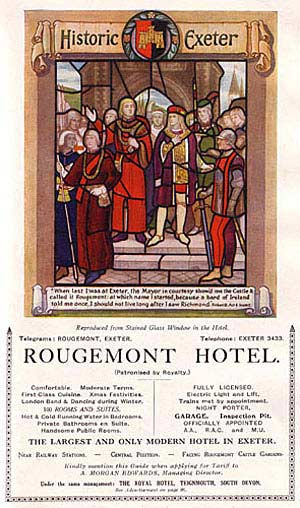 An advert from the 1930's depicting
the stained glass window by Frederick Drake.
An advert from the 1930's depicting
the stained glass window by Frederick Drake.
│ Top of Page │