
 Join the Exeter Memories
 Catherine Street
Page updated 28th October 2016
Catherine Gate
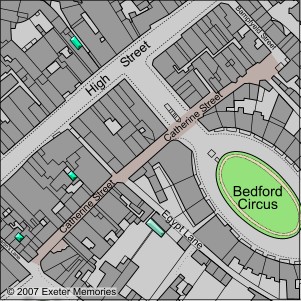 Apart from Little Stile, Catherine Gate is
the least visible of the seven gates of the modern Cathedral Close. Indeed,
since the refurbishment of the modern
St Catherine's Square, during 2005, there appears to be no reminder of
the position of the old gate.
Apart from Little Stile, Catherine Gate is
the least visible of the seven gates of the modern Cathedral Close. Indeed,
since the refurbishment of the modern
St Catherine's Square, during 2005, there appears to be no reminder of
the position of the old gate.
St Catherine's Gate was situated by St Catherine's Chapel and had
been
marked by an iron ring in the retaining wall of the flower bed in St
Catherine's Square. Before St
Catherine's was built around about 1457, the gate was named Bickleigh
or Berkly, a corruption of Ercevesk, because it was situated next to
the house of Canon Ercevesk.
The street
Catherine Street runs from the corner of Cathedral Close, by St Martin's Church to Bedford Street. Before 1942, it ran parallel to the High Street as far as Bampfylde Street. It was one of those thoroughfares that was laid out during the time of King Alfred in the 9th-century. Prior to 1942, it was a narrow congested street full of pubs, shops and small businesses.
The street took its name from St Catherine's Chapel situated on the corner of Egypt Lane. However, it had been known by other names in the past. The historian George Oliver claimed that a length of lane from the corner of St Martin's Lane to the almshouses had once been named Paternoster Lane. A deed of 1280, names the street running from St Martins Church to the Dominican Friary as Doddehaye-strete. It retained this name until the 15th century when started to assume its present name. Hoskins asserts that 'Doddehay' was derived from a Saxon landowner named Dodda, with the 'hay' referring to an enclosure of land, as in Southernhay, Northernhay and Bonhay.
Council improvements
During the 19th-Century it was a street in a not particularly good condition, with one concerned Exonian blaming, in 1840, the Dean and Chapter for its poor state. In 1885, the Streets Committee voted to have the road surface metalled, thus covering over the ancient pebbles, and widening the footpaths, between Cathedral Yard and Bedford Street. One scheme, proposed by a member of the Streets Committee, was to extend Queen Street across the High Street by widening Martins Lane, cutting across Catherine Street and demolishing the Swan Inn and the houses that were on the site of the present Oddfellow's Hall, pushing past the rear of St Martins Church, through the gardens at the rear of the houses lining Cathedral Close, down as far as Southernhay. Suffice to say, it was not supported; it seems City Councillors have always been megalomaniacs.
Local Hostelries
The Swan Inn was a City Brewery house in the late 19th Century. In 1905, there were two planning applications for the premises by the brewery–the first was to rebuild the first floor bay windows, and the second to install a hinged flap in the pavement, to allow the lowering of barrels into the cellar - both were granted. It was sold to Mr Plummer in June 1923 to become part of Colson's, now the House of Fraser.
The even older Country House Inn, was situated beside the almshouses, and originally had a malthouse attached. It, along with the almshouses, were on the remains of a previous 13th century canonry. A covenant in an 1814 lease states "give up the chamber over the gate", indicating the position of Catherine's Gate–the gate was demolished the same year – it was probable that the inn opened at this time, as the first listing in a directory was in 1816. Its lease was purchased from the Ecclesiastical Commissioners for £225 by the City Brewery, in February 1878. The freehold was purchased in November 1887, for £1,000. During the 19th Century it issued brass tokens made by Seage. The building was reputed to be 500 years old, on the site of the Annuellers College, it was destroyed in the 1942 blitz. N&P sold the site to ECC for £8,000 in 1955. The licence was transferred to the John Bull Inn.
Oddfellow's Hall, now housing a shoe and coffee shop and hairdresser, is just behind St Martins' Church, on the corner of Cathedral Close. Designed by Ralling and Tonar, of Bedford Street, it was constructed by the builder, Brealy. The foundation stone was laid in June 1896 by Brother P.G. Mansfield, who had been presented with a mallet and silver trowel by Octavius Ralling to perform the task. The inaugural meeting was held in the Hall in September 1896.
Opposite St Martins Church, No., 1 and 2 Catherine Street, at the entrance to Catherine Street, are two early 15th century, three storey, timber-framed gabled houses. They have later, Georgian sash windows and casements, and the corner building has an oriel window, flanked by hanging slates, over the shop frontage. There are many internal features, including screens, fireplaces, garderobes and late 16th Century painted decoration on the joists and beams, and a cruck roof. There is evidence that John Whytten, a mason signed an agreement to build them on 14th September 1404, for the cost of £6 6s 8d. The houses were probably built to accommodate priests and were converted into shops in the 17th-century. From 1961, It was for the SPCK Christian bookshop, until they closed and is now occupied by Gemstar, jewellers.
The modern era
Some concession towards modernity was made, when Mr H E Williams opened the Devon Cycle Company at Nos. 40 and 41 Catherine Street in 1892. He offered a wide range of perambulators, mail carts, and invalid, Merlin and Spinal chairs, alongside the more conventional bicycles and tricycles, priced between £2 and £19 15s. His business evolved into the Devon Motor Works.
And what of the modern Catherine Street? Little remains of this ancient thoroughfare in the city. What the modernisers of the first half of the twentieth century did not destroy, the Luftwaffe managed to remove in 1942. Apart from the first two buildings on the corner of Martins Lane, and Oddfellow's Hall, nothing remains. The new Catherine Square is on land formerly occupied by a tight group of house and businesses, and the old ring, denoting the position of Catherine Gate, has long gone. As has half the street, for the section from Bedford Street to Bampfylde Street became an ugly service road for the first Princesshay, and has remained as such, for the second incarnation of that shopping paradise.
Sources: The City Brewery Exeter, by Geoffrey Pring. Two Thousand Years in Exeter by W G Hoskins, reports from the Streets Commission in the local newspapers, British Listed Builidings.
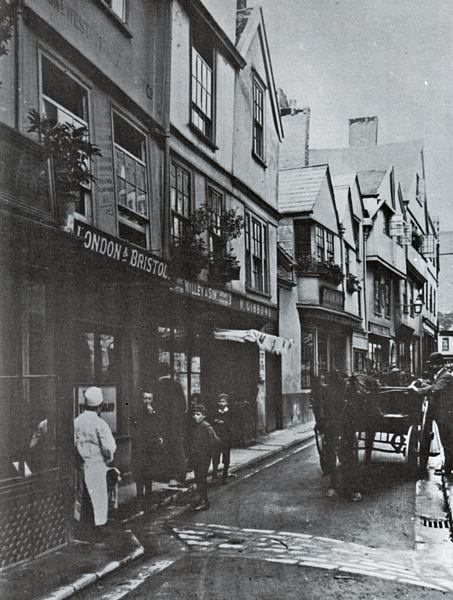 Catherine
Street in the late 19th Century – the Swan Inn is behind the
horse.
Catherine
Street in the late 19th Century – the Swan Inn is behind the
horse.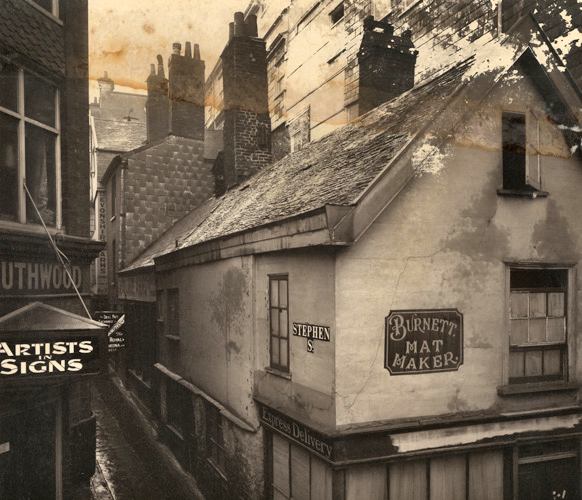 The corner of Catherine and Stephens Street – view towards St Stephens Bow. Courtesy Westcountry Studies Library.
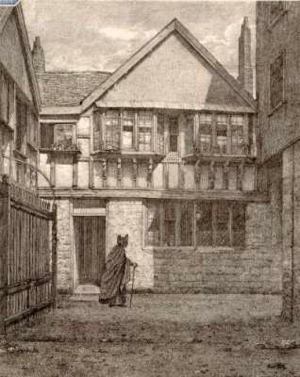 The facade of a half-timbered house on Catherine Street around about 1850.
 1 and 2 Catherine Street.
 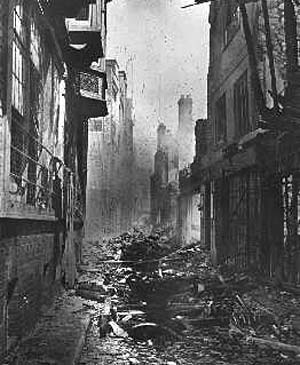 Destruction in Catherine Street
after the May 1942 blitz.
Destruction in Catherine Street
after the May 1942 blitz.
│ Top of Page │