
 Join the Exeter Memories
 King Street
Page updated 19 September 2009
 King Street is found in
the West Quarter running at right angles from Fore Street to Preston
Street. It was named King Street in 1834 in honour of King William IV,
having formerly
been known as Idle or Idol Lane.
King Street is found in
the West Quarter running at right angles from Fore Street to Preston
Street. It was named King Street in 1834 in honour of King William IV,
having formerly
been known as Idle or Idol Lane.
A letter was printed in January 1874 in the Flying Post of one man's memories of the the area, prompted by the laying of a foundation stone for the new Industrial Dwellings at Mermaid Yard. The author wrote "Preston-street, Rack-street and Idol-lane - the remains of many of the old houses which were in the occupation of some of our city magnates are still to be seen... In Idol-lane (now called King-street by "Young Exeter,') we have Mr. Richard Traer, woolstapler. On a great fire taking place at Mr. Wm. Pim's, baker, Smythen-street, more than a half a century ago, the back premises of which property came near the wool warehouse of Mr. Traer (the site now occupied by the new Wesleyan Schools), great consternation was caused in the immediate neighbourhood, and the wool packs were rolled into Idol-lane to prevent their being burnt."
James Cossins wrote in 1877 - "King street (Fore street hill) was formerly occupied by two shops, with premises behind, one a comb manufactory, but is now a direct line to that useful and desirable establishment, the baths and washhouses." This was a direct memory of one business that was lost.
Adverts for properties for sale indicate the street changing as Exeter lost its woollen trade. Properties that had formerly been owned by merchants, and fullers, were up for sale, shop keepers were selling up and the area becoming residential with many new, closely packed courts and places. In 1807 a dwelling house and detached ware rooms (warehouse) were for sale; the present owner was a fuller and hot-presser, both component parts of the woollen serge manufactory. The whole was suitable for any business that "required much room." In 1822 a Waggon Warehouse became vacant and through the whole period, many houses with attached warehouses were offered for sale.
A way was made through the old, narrow alley to Fore Street in 1834, when its name was changed. As businesses closed, workers moved into the houses, which were often split into tenements, and the West Quarter became a working class, poor area. King Street was no exception and it had its share of interesting characters and events. Around about 1840 there lived in the street, Mark Elms who gained a reputation as a fence - he was arrested for being in possession of stolen property from a robbery in Taunton.
The Public Wash-House
The far end of King Street, beyond where the street crossed Rack Street, was the site of the public wash-house which opened on 9th August 1852. Its purpose was to provide sanitary washing facilities for the poor of the district, who often had no cold water supply to their court, never mind into their house. The cholera outbreak of 1832 resulted in five in King Street dying of the disease, The installation of improved facilities such as the public wash house did reduce further epidemics, but serious disease still stalked the street. In December 1871 two cases of small-pox were reported, one in King Street. The victim had been removed to Whipton for care, and the medical officer for the Workhouse reported, at the same meeting, an increased number of sick people admitted into the institution's hospital. In 1885, a case of scarlet fever was reported in King Street, and, although not an epidemic, it was not an uncommon occurrence.
In 1890 it was noted that King Street was where female 'pugilists fought before an admiring audience'. Later, in 1899 it was reported that dirty and verminous children were investigated by the inspector of the Society for the Protection of Children. Clearly, this was a forgotten corner of Exeter. The street has been rebuilt since the clearing of the West Quarter in the 1930's. The King's Dwellings, built by the Exeter Workmen's Dwellings Co Ltd were a block of fifteen, three and four storey flats. The were opened on 12 September 1933, in a scheme in which one slum was replaced with one modern dwelling. King Street was in area No 4, a high priority area for slum clearance.
And for all those who research their family history, King Street contains the Devon Family History Society's, Tree House Research Centre.
World War One Dead - King Street
Private, William Ford, Reserve Cavalry Regiment. 19 May 1919. Age 53. King St
Source: Various sources including Victorian Exeter by Robert Newton, the Flying Post, James Cossins and notes from the Exeter Industrial Archaelogy Group 1975.
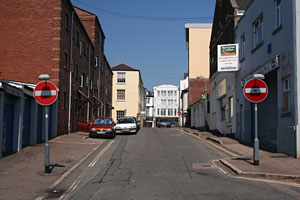 Kings
Dwellings left. Three of the five victims of the cholera in King Street
died on the site of the buildings on the right. The Wesleyan School,
mentioned in the text can be seen beyond the large sign. The DFHS Tree
House
Centre is based in these buildings.
Kings
Dwellings left. Three of the five victims of the cholera in King Street
died on the site of the buildings on the right. The Wesleyan School,
mentioned in the text can be seen beyond the large sign. The DFHS Tree
House
Centre is based in these buildings.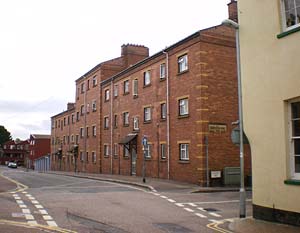 The Kings
Dwellings, dating from 1932, from the other direction. The corner was
the
site of a fish and chip shop.
The Kings
Dwellings, dating from 1932, from the other direction. The corner was
the
site of a fish and chip shop.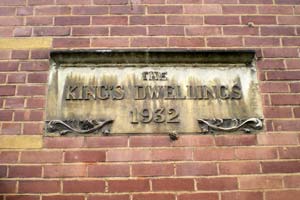 The plaque
on the wall of Kings Dwellings.
The plaque
on the wall of Kings Dwellings.
│ Top of Page │