
 Join the Exeter Memories
 Hooker Statue
Page updated 7th November 2019
 Richard
Hooker was born in Heavitree in 1554 and educated at Exeter
Grammar School. He went on to study at Corpus Christi College, Oxford
in 1567, sponsored by Bishop Jewell of Salisbury. He gained a
fellowship in 1581.
Richard
Hooker was born in Heavitree in 1554 and educated at Exeter
Grammar School. He went on to study at Corpus Christi College, Oxford
in 1567, sponsored by Bishop Jewell of Salisbury. He gained a
fellowship in 1581.
Hooker had few social graces and is said to have asked his landlady to find him a wife. He married Joan Churchman in 1584, and after a short time in Buckinghamshire he moved to London as Master of the Temple until 1591. He moved as vicar to Drayton Beauchamp and then Boscombe, near Salisbury
His sermons were considered best avoided. However, as a religious thinker, he travelled the country, preaching and arguing his views. Some consider him the 'father of Anglicanism' for his Ecclesiastical Polity, published in 1594, a radical book on religion, which argued that the church should take a middle way, and not be too puritanical. He died in 1600, at Bishopbourne near Canterbury.
The unveiling
The statue is carved out of white 'pentilicon' marble*, weighing 2 tons 1 cwt (2082 kilos), and originally had a grey granite base. The granite base was supplied by J Easton and Son of Exeter, from their Blackenstone quarry, Moretonhampstead, and stands in the centre of the ancient Cathedral common burial ground. It was sculpted by Alfred Drury ARA (1856-1944), at a cost of a thousand guineas, paid for by Mr Robert H Hooker of Weston Super Mare, a descendent of an uncle of Hooker. Drury used a portrait by a Flemish artist that is held in the National Portrait Gallery, and was given to the gallery by his family descendents.
The statue was received by the Bishop of Marlborough, while the Bishop of Exeter received the gift, at a service in the cathedral, on 25 October 1907. There was a procession to the statue, where the Bishop of Exeter unveiled it. There was a large crowd in attendance. Music from the 16th Century was played at the service.
It depicts the 'Judicious
Hooker' as he was known, seated with his book. Within a few
hours, postcards of the statue were for sale in Worth's Gallery at
Mols Coffee House.
Drury also created a bronze statue of Sir Joshua Reynolds, a Devonian,
that stands in the courtyard of the Royal Academy.
The move
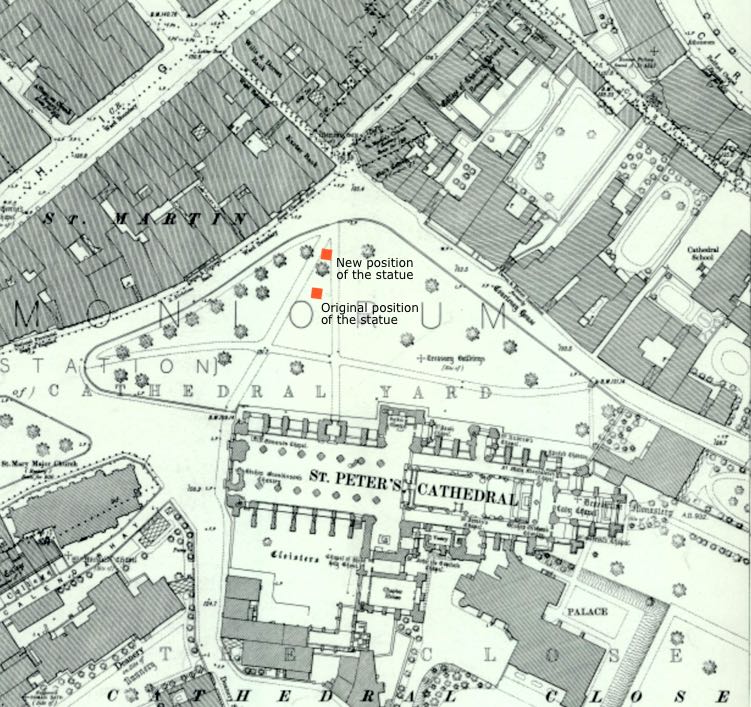
In October 2010, the Cathedral Authorities, in a £600,000 project, replanted the trees on the Green, relaid the footpaths and moved the Hooker statue some 5 metres forward, on to a new plinth, to face the northern entrance at Martins Lane. The statue can now be viewed at closer quarters, without having to step onto grass.
*Pentilicon marble was used for building the Parthenon in Athens. The best is a pure white marble normally only quarried in Greece. Due to past exploitation, the marble that is now quarried tends to be greyer in colour.
Source: Exeter Flying Post, Exeter and Plymouth Gazette, and various websites.
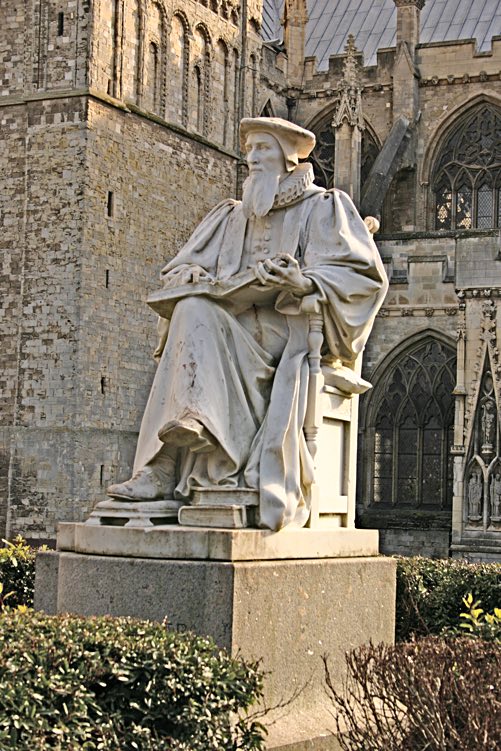
The statue of Richard Hooker before 2010.

Covered in snow, Hooker contemplates the white, Cathedral Green.
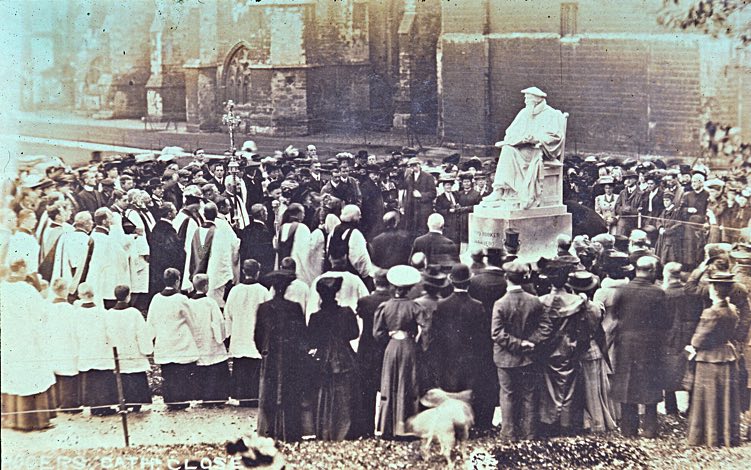
A postcard showing a large crowd attended the unveiling of the statue in 1907.
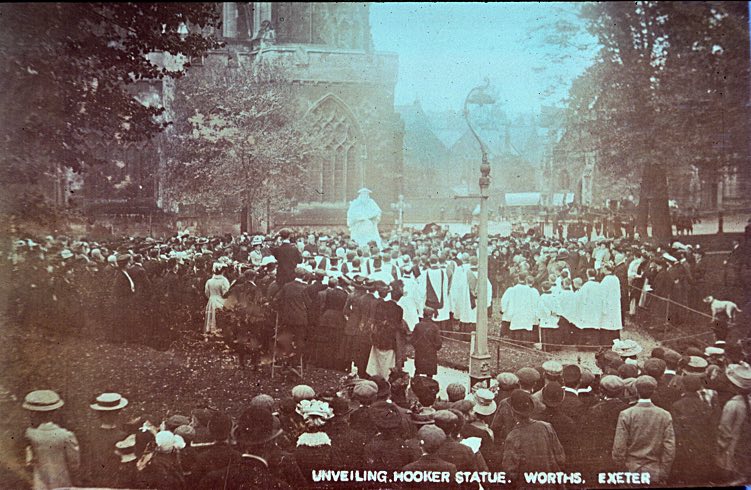
Another postcard view of the unveiling.
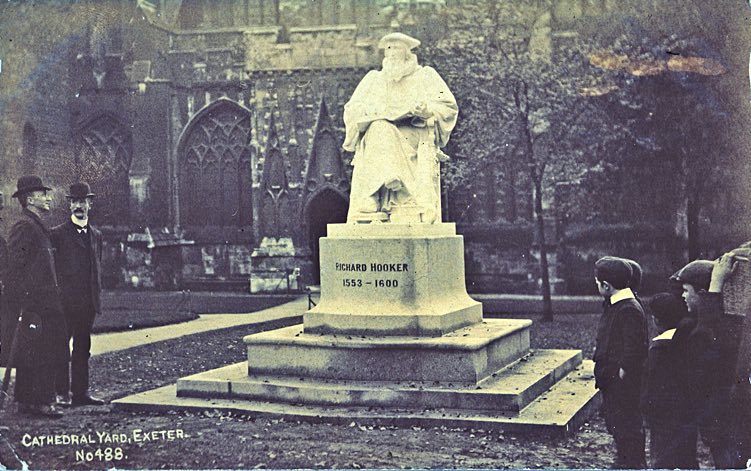
The statue being inspected by some boys, shortly after the unveiling.
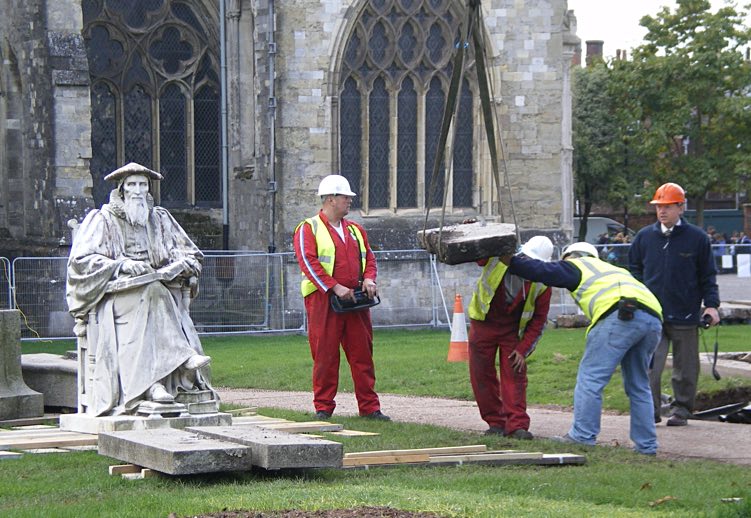
Workmen, have removed the statue from its plinth in preperation for the move closer to the Royal CLarence Hotel.
│ Top of Page │