
 Join the Exeter Memories
 St Leonard's Church - Topsham Road
Page updated 21 May 2009
The parish of St Leonards was the smallest parish in Devon and most rural close to the city wall, until 1877 when it was absorbed into the County of the City of Exeter.
The first chapel on the site of the present church was built by Richard of Redvers, the 1st Earl of Devon or his son Baldwin in the first half of the 12th century. In 1222 the parish boundaries were defined. Sixty or so years later, Master Lucas, a priest of St Leonards was implicated in the murder of Walter Lechlade, in Cathedral Close in 1283.
In 1566, a new church was built with the patronage passing from the Courtenay's to the Hulls of Larkbeare, after Henry VIII executed Henry Courtenay in 1538 for treason. During the Civil War, the Royalist defenders of the city fortified the church, as well as Mount Radford house.
In 1833, this church was replaced by another, built in the Classical style by Andrew Patey at a cost of £1,400. It was enlarged in 1843 for £800, of which, £500 was a gift from Sir Thomas Baring, who owned most of the parish. In 1873, just three years before the church was replaced, a new organ was installed by Speechly and Ingram of London; the organist for the inauguration was a thirteen year old girl named Miss Mare, who played a rousing version of the 'Hallelujah Chorus.' The building had a curious thick iron plate roof, and perhaps was the reason why this novel building was demolished after 40 years, as it had become structurally unsound.
The present church dates from 1876 when the Earl of Northbrook laid the foundation stone for "a thanksgiving for his safe return from India". S Robinson was the architect, aided by John Hayward's son. The opening ceremony was in May 1877 with Archdeacon Sanders preaching the first sermon. The church is in a Decorated style and has a chancel, clerestoried nave, aisles, and a west porch and had seating when newly constructed for 570 sittings. In 1881, Mrs L A Miles, in memory of her husband, paid £2,457 for the 145ft spire which was complete by 1884. The register dates from 1708. The church is now run in an evangelical Church of England style.
Source: White 1850, Kelly's 1897, Flying Post
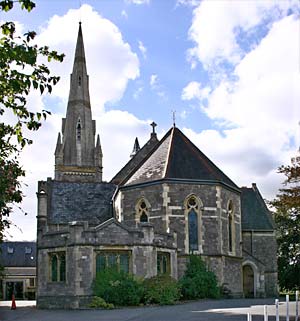 St
Leonard's Church.
St
Leonard's Church.
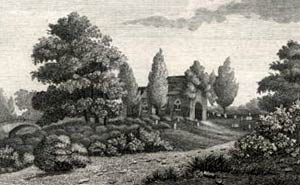 Old
St Leonard's Church.
Old
St Leonard's Church.
│ Top of Page │