
 Join the Exeter Memories
 The Rusty Bike
formerly the Eagle Tavern
Last update 30 April 2014
Back to Pubs of Exeter
Also see Running the Eagle Tavern
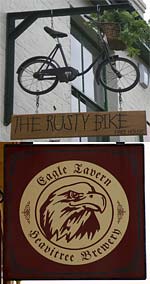 This public
house, recently reopened after three years closure, and renamed
the Rusty Bike, by its new owner Mr Hamish Lothian. The Rusty Bike is
not Mr Lothian's only public house in the city, for in February 2008 he
purchased and refurbished the old Coachmakers
Arms in Smythen Street, renaming it the Fat Pig. It took ten
weeks to refurbish the old Eagle Tavern, and the use of a rusty bike as
a pub sign signalled the opening of the new pub in September 2009.
This public
house, recently reopened after three years closure, and renamed
the Rusty Bike, by its new owner Mr Hamish Lothian. The Rusty Bike is
not Mr Lothian's only public house in the city, for in February 2008 he
purchased and refurbished the old Coachmakers
Arms in Smythen Street, renaming it the Fat Pig. It took ten
weeks to refurbish the old Eagle Tavern, and the use of a rusty bike as
a pub sign signalled the opening of the new pub in September 2009.
The history
Howell
Road was originally known as Red Lane
because of the, rich, red Devon soil. It
became Barrack Road at the end of the 18th Century, when the Higher
Barracks were built in 1792 at the time of a feared French invasion
under Napoleon.
A pub was first listed on this site in 1815, named The Marquis of
Wellington. However, Wellington was first made a Duke in May 1814,
which suggests that it opened and was named
before that date. It could have opened as early as 1808, when Arthur
Wellesley was promoted to Lieutenant-General and more importantly, came
to the public's notice with two
victories against the French in the Peninsula War.
Pigot's 1832/3 edition had caught up with Wellington's title
promotion
and the pub was named the Duke of Wellington, with Richard Tapper as
the innkeeper. It changed its name
again by 1833 when it became known as the Spread Eagle, as shown in
this advert from Trewman's Exeter Flying Post.
TO
PUBLICANS
ELIGIBLE SITUATION FOR BUSINESS
To be LET, for a Term of Years, with immediate possession, all that
well-accustomed PUBLIC HOUSE, called the SPREAD EAGLE, situate close to
the Cavalry Barracks, in the Parish of
Saint David, and possessing every convenience for carrying on an
extensive trade.
For viewing, and other particulars, application may be made to Mr
Simon
Hore, St Thomas: or to Mr SAMUEL KINGDON, solicitor, Bedford-street
Exeter, 18th October, 1833
The Spread Eagle
The innkeeper, probably just before the above advert in 1833, was B. Richards. Sid Rowsell, a former landlord of the Eagle believes that the name, Spread Eagle, derives from the Spread Eagle Standard carried by Napoleon's troops at Waterloo. Sergeant Ewart of the Royal Scots Dragoon Guards is credited with capturing a Standard from the French, which is held to this day by the regiment. It became known as the Eagle Tavern in 1844 with William Crabb as landlord, and in December 1846, the tavern was for sale by auction as the owner, Mr Salter was leaving the public-house trade.
In the 1850 White's
Devonshire Directory, John Martin was listed as landlord and was
running a quadrille band which he hosted to its annual supper; the band
had been formed two years before and was engaged to play at the
Cullompton Ball in 1850. It would appear from census records that John
Martin went on to run the Kings Arms in St
Sidwells. The license was transferred from Mr Martin to William Pinney
in October 1855, and by 1859, it was known as Pinney's Spread Eagle.
After an epidemic of Asiatic Cholera in 1866, the City Corporation
discussed using the premises as an isolation hospital for new cholera
cases, but the plans were never put into
action.
Between 1860 and 1880 the Eagle Tavern, along with many other
public
houses at the time, issued tokens to its customers to increase sales,
made by Charles Dipple
of Birmingham. In December 1865 there was a sale of household goods, brewing
utensils, stock in trade, and skittle alley at the Eagle Tavern, the
effects of Mr Clarke. The changes of licensees continued in 1869 when
Mr Abbot took over from Mr Knight. Samuel
Reed was in charge of the Eagle Tavern in 1871, and in June 1873 E
Langford announced his occupancy, and his improvements to the pleasure
and recreation grounds attached to the house, as well as the stocking
of Burton Ales.
Samuel Reed was in charge of the Eagle Tavern in 1871, and in June 1873 E Langford announced his occupancy, and his improvements to the pleasure and recreation grounds attached to the house, as well as the stocking of Burton Ales.
The world record walk
It was under the landlord, Richard Lethaby that a long forgotten feat of endurance, and world record attempt was made in the Eagle Tavern’s pleasure garden. On 19 June 1877, twenty year old Mademoiselle Price (aka Eda Anderson) started her 1,000 mile walk in 1,000 hours. By the 12 July, she had reached 554 miles, completing the walk on 31 July. She walked a mile in about 15 minutes, and then rested for the rest of the hour. Engaged to do the marathon by Mr Martin, who ran the Northernhay Skating Rink, Price slept in a tent in the grounds, while a bedroom at the Eagle Tavern was occupied by her assistant.
The event ended in acrimony, when one evening Mrs Lethaby presented Price with a bill for the use of the tavern’s facilities. Lethaby went on to tell Price that unless she paid, she was to stop walking, and end the attempt. Price said “You can take the things, but you won’t have any money”, just as Mrs Lethaby picked up a tray of cups and saucers. Price then struck the tray, breaking the crockery, and then threw some in Mrs Lethaby’s face. Mr Lethaby appeared and called a policeman–in the meantime, Price is said to have used a horse-whip to thrash Mr Lethaby. The magistrate found Price to be guilty of both assaults, and fined her for both, with additional costs for the damage. Whether Mademoiselle Price broke her own walking record is not reported.
The Heavitree Brewery took the inn over in 1892. In 1897, Kelly's Directory listed Edward Ernest Hill as the publican while in 1923, the landlady was a Mrs Emily Hill, possibly the previous incumbents wife.
The Twentieth-Century
It was in 1928 that Sonny (Charlie) and Rose Stone ran the public house eventually moving on in 1945. Then Richard Green and his wife Minnie, daughter of Sonny and Rose took over - in later years they were increasingly helped by Sid Rowsell and his wife Joan, Minnie's daughter, taking over in 1973. Joan Rowsell's father was her mother's first husband, George Shelton who ran the Bull with Minnie, in Goldsmith Street. George was a retired Exeter City footballer who died at the early age of 32. The Rowsells stepped down and Harry Peprell took over in 1975.
There was a flurry of indignation from the publican and regulars in September 1981, when the Co-op announced plans to use the garage next door as a mortuary. The landlord used the Express & Echo to great effect, to stop the plan. Later, in the 1980's, the former Exeter City star striker Tony Kellow was landlord. He was the highest scoring Exeter City footballer ever, with 129 goals. The Eagle Tavern has lost trade in the last few years and has closed for brief periods. It closed on 6 June 2006, only to reopen in 2009 as the Rusty Bike.
Source: Express and Echo, and Additional material courtesy Steve Coombes. Kelly's, Besleys, Whites and other county directories. © 2005 David Cornforth - not to be used without permission
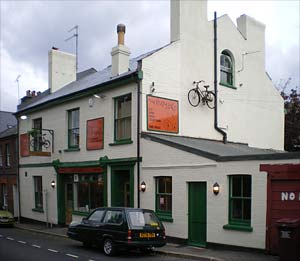
The Rusty Bike.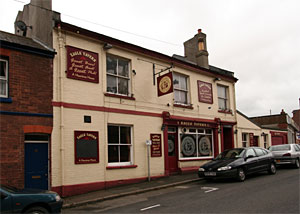
The Eagle Tavern.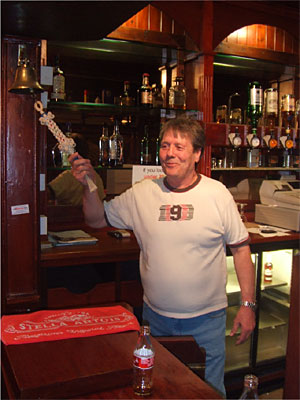
The landlord rings last orders
for definitely the last time.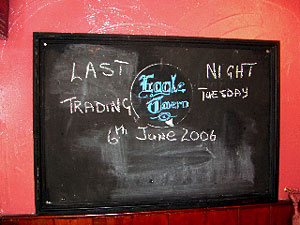
The blackboard on the last night of the Eagle tavern before final
closure.
│ Top of Page │