
 Join the Exeter Memories
 The White Hart Hotel
Page updated 26th January 2014
 There is
reason to
believe that the White Hart was
the home of William Wynard, recorder of Exeter, between 1418 and 1442. Wynard built Wynard's Hospital and Chapel, in 1430, for a priest and twelve infirm or poor men. He
endowed his house, along with other property, on 20 January 1436, to Wynard's as a source of funds for the hospital, when
it became the Blue Boar Inn. The Blue Boar was the heraldic badge of
Richard, Duke of York (1411-1460), father of Edward IV (reigned
1471-1483).
There is
reason to
believe that the White Hart was
the home of William Wynard, recorder of Exeter, between 1418 and 1442. Wynard built Wynard's Hospital and Chapel, in 1430, for a priest and twelve infirm or poor men. He
endowed his house, along with other property, on 20 January 1436, to Wynard's as a source of funds for the hospital, when
it became the Blue Boar Inn. The Blue Boar was the heraldic badge of
Richard, Duke of York (1411-1460), father of Edward IV (reigned
1471-1483).
Eventually, it became as the White Hart Inn. Located at the bottom of South Street, just inside the city wall and close to the position of the South Gate, which was demolished in 1819, the White Hart was well placed to stable pack animals and horses along with their wagons and carriages. The name represents Richard II's (reigned 1377-1399) heraldic symbol. A white hart was very rare and reserved for only the king to hunt. Additionally, it has been speculated that it was also a pun on his name - Rich Hart. In 1393, King Richard passed an act making it compulsory for inns and taverns to have a sign hanging outside so that the official 'ale taster' could easily locate them. Really checking to make sure they have paid the right duty on the ale!
The Cockatrice
Richard Izacke documented an accident at the White Hart in 1649, in the year of Charles I execution. The inn had an old well that had long been neglected. The White Hart's owner, Roger Cheek, employed Paul Penrose to climb down the well to repair it. At the bottom, Penrose suddenly fell dead, suffocated by ‘an uncommon stench’. A second workman, named William Johnson, was called to go down and investigate. When he reached the bottom, he too fell dead.
A friend of the men wishing to help his workmates, also descended the well, and almost died himself, but was pulled back up—he rolled around in agony, to be revived with water and oil. When he recovered, he said that there was a strong smell that hindered his breath. Some onlookers said that it was a Cockatrice (a legendary creature that is part lizard, part rooster) that caused the deaths, but most agreed that it was the Damp or some sort of marsh gas.
The burial records of St Sidwell's Church record that William Will was buried on 28th June 1649, having died of a damp of the well, at the sign of the "White Hart" in South Gate Street.
In the 18th and early 19th Centuries, the inn's proximity to the old Southgate, it became a busy hub for carriers across Devon, with services to Axminster, Beaminster, Beer, Seaton and Ilminster, among others. Competition was intense, with the nearby Mermaid and Dolphin Inns, and Russell's Carriers, based just up South Street.
Cholera and elections
In 1832, all the inns and hotels of the city experienced a dramatic drop in guests, as the cholera swept through the city. The West Quarter, of which, the White Hart was on the edge, had the highest number of deaths. The Exeter and Plymouth Gazette noted on the 15 September that the epidemic appeared to be abating and that guests were returning, including a number of commercial gentlemen to Wethey's White Hart.
In 1835, the independent candidate, E Divett M.P., used the hotel as a campaign base for election to Parliament. The very limited franchise at the time, led to the buying of votes, and the dinner for 80 (not the first either) held at the White Hart, was probably just part of the price paid to be re-elected.
Cycling Club
In common with many other inns and taverns in the city, through the 19th and early 20th Century, the White Hart was host to annual dinners, for clubs and society meetings. Some odd dinners, by our standards, were held at the hotel including this in May 1906:
"The annual rook pie lunch took place at Mr. Wethey's White Hart Hotel, South-street an excellent repast being thoroughly enjoyed by a large attendance."
One club that used the White Hart, was the Exeter Touring Cyclists Club, which was formed in the late 19th Century. In February 1912, they made the hotel their official club headquarters. After the Great War, membership had fallen dramatically, with many members not returning from the war, and the advent of the motor car. In April 1921, the club was formally wound up, at the White Hart, and £5 10s 6d donated to the Royal Devon and Exeter Hospital.
The license for the White Hart was held by the Wethey family for over 200 years, up to 1937, when it transferred out of the family to Joseph Rowe Brooking. It appears that they would occasionally install a landlord to run the place. Some of the landlords of the White Hart in the 19th and 20th-centuries can be listed as:
1827 - John Wethey
1839 - Wethey Jno, White Hart commercial inn, South St
1844 - John Sumners
1868 - Pollard's White Hart Hotel
1878 - Hookway
Wm. Hy. (W.& Co.)and victualler, White Hart, 66 South Street
1897/1903 - William Youlden Wethey
1903/1937 - Edmund Wethey
1937 - Joseph Rowe Brooking
1956 - Davy and Co Ltd
John Wethey placed the following advert in the Gazette in January 1840, after he refurbished the hotel:
WHITE HART
COMMERCIAL and FAMILY HOTEL,
SOUTH STREET, EXETER.
JOHN WETHEY, Proprietor of the above Inn for the last Twelve Years, offers his sincere thanks to Commercial Gentlemen, Families, the Yeomanry of Devon, and the Public generally of this City and neighbourhood, for the steady and liberal patronage he has experienced.
He avails himself, also, of the present opportunity, to state that his progressively increasing business has led to considerable improvements in his Establishment, which he trusts will materially conduce to the additional comforts his Friends; and he very respectfully assures them that no exertion on his part shall be wanting to secure their future support and approbation.
EXTENSIVE AND COMMODIOUS STABLING,
With Loose Boxes, Lock-up Coach House.
WELL-AIRED BEDS.
WINES, SPIRITS, HOME-BREW'D BEER, PORTER,
CIDER, &c., of the very best quality.
AN ORDINARY EVERY FRIDAY AT ONE O'CLOCK.
I assume that Friday at one o'clock was happy hour!
The building
Although the history of the White Hart can be traced back to the early 15th Century, the façade in South Street presents a three storey, late Georgian, roughcast exterior, with rusticated quoins, the whole of which is painted white. The first floor has four sash windows, with the central pair joined to form a single window—it is thought that it may have replaced a casement. There is a simple cornice over the parapet, with a pitched, slate roof behind.
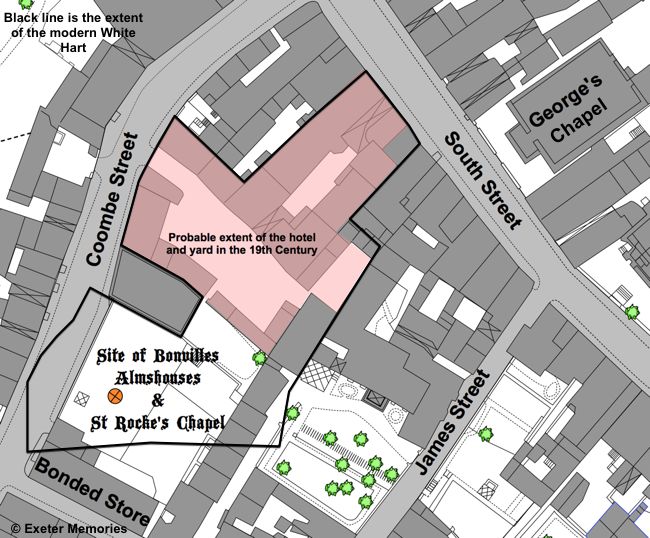
The front door, which is 19th Century, leads into a sloping, cobbled and flagged passageway, and then opens into a small, enclosed courtyard. Internally, the building is thought to be 16th Century, although much of the woodwork, including a Gothic glazed door, leading to a staircase, is of late 18th and early 19th Century. There is a semi-circular stairwell, which may be mediaeval. The various bars and function rooms have been modernised. To the rear, where the old yard would have stood, there are various extensions, and a modern hotel block fronting Coombe Street. No 34, The Old Ale and Porthouse, to the left of the main building, is incorporated into the hotel.
The modern inn has 55 ensuite bedrooms, of which, 15 are situated in the historic part of the building. It has welcomed such luminaries as the exciting Monty Pythons Flying Circus team, when they were filming in Exeter, and Steve 'Interesting' Davis the snooker player. In 2010, a fire in an electrical store forced the evacuation of 60 guests. The musician, Chesney Hawkes, along with his band, who were staying at the hotel, returned to the hotel after he played at the University.
The building was Grade II listed on the 29 January 1953.
Sources: Flying Post, Western Times, Jenkins History of the City of Exeter and its Environs 1841, various trade directories and British Listed Building (English Heritage)
 The
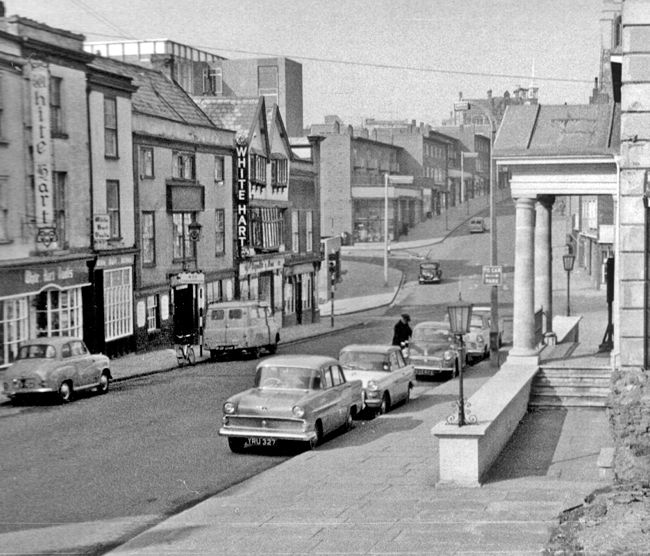
White Hart circa 1960 was scruffier than the modern hotel. Photo
courtesy Dick Passmore.
The
White Hart circa 1960 was scruffier than the modern hotel. Photo
courtesy Dick Passmore.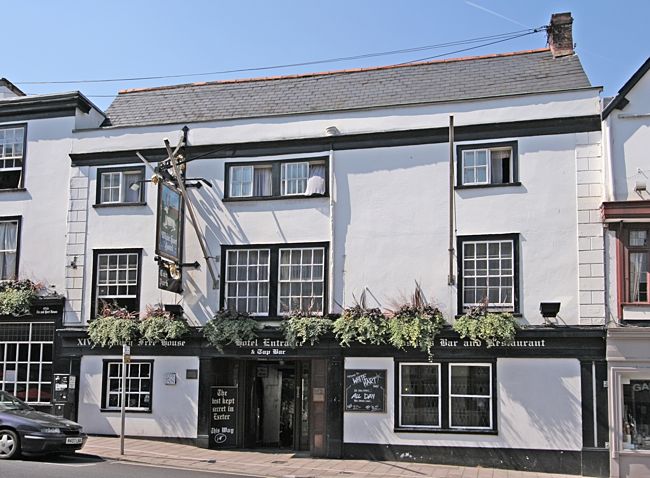 The Georgian front of the White Hart Hotel.
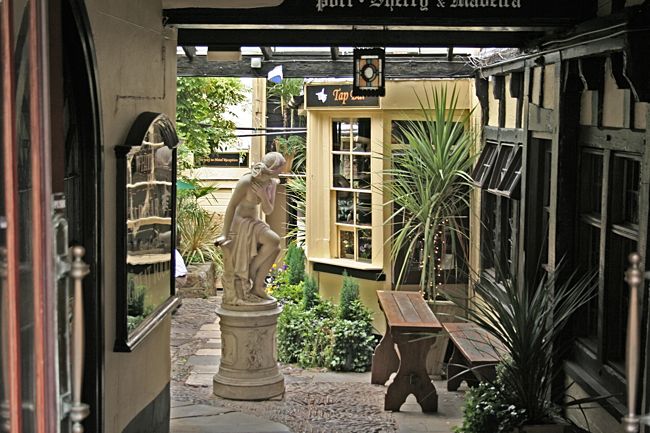 The cobbled entrance leads to a small, picturesque courtyard.
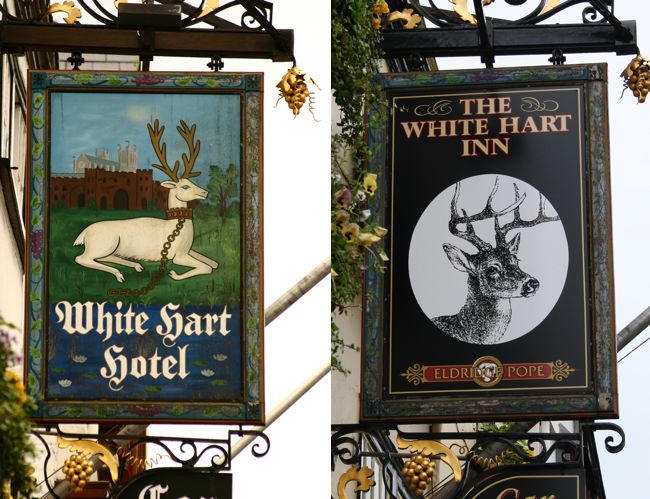 Previous White Hart sign, left.
│ Top of Page │