
- Home
- Memories
- Scrapbook ▽
- Topics ▽
- People ▽
- Events
- Photos
- Site Map
- Timeline
Page updated 21st April 2012
Back to
buildings
Also see Photos of Deller's
On the right hand corner of the High Street and Bedford Street, there stood the Half Moon Hotel. It opened in the mid 17th century, as one of the largest hotels in the city. Local merchants would meet in the early part of the 19th century to talk business, and enjoy a glass of grog and a clay pipe of tobacco. Sullivan, of the operatic fame, first performed the music of the Mikado to Gilbert in the hotel. The hotel was demolished in 1912 and replaced by the single storey, Lloyd's Bank.
In 1868, a 20 year old Ipplepen man called William Lambshead, was employed to manage the Deller's grocery store in Winner Street, Paignton. He married the owners daughter Elizabeth Ann, giving him the opportunity to expand the business into other areas. A prominent Methodist, Lambshead, along with other similar minded entrepreneurs, was largely responsible for the expansion of Paignton town centre around the site of Lloyds Bank and Palace Avenue. He was also chairman of the committee that built Venford reservoir to supply water to Torbay and was instrumental in introducing electricity to Paignton
Lambshead's two son's Herbert and William were brought into the business. They were charged with opening branches elsewhere, and it was Herbert who decided that Exeter would be a good place for a Deller's Café.
On Wednesday, 31st October 1906, Deller's opened its first café in the old Exeter Bank premises, next door to the Royal Clarence Hotel, and on the corner of Martin's Lane. A few years later, Deller's decided to build another café, this time on land next to Lloyds Bank. The premises would be substantial and part would be on top of the bank to create a large café, complete with function rooms.
Built in the grand baroque style, the building was opened in December 1916. Local firm W Brock & Co fitted out the ballroom and supplied furnishings, blinds and curtains for other parts of the café. Advertised as 'one minute from Trams', the grand entrance of the Café of the West was in Bedford Street, next to the bank and it fast became a meeting place for the local young people of the time, and a favourite of visitors. There were ornately decorated balconies around the main atria, where patrons could enjoy a light lunch, or tea, to the sound of the in-house 'Gwen Master and her Orchestra' who performed between 1 and 2, 3.45 and 5.45 and 7 to 8 in the evening.
Many a romance blossomed within the walls of Deller's and for 25 years, Deller's was the centre of social life in Exeter. A discrete meeting for tea with tea cakes led to many a happy marriage, at a time when it was shocking for a lady to smoke a cigarette. They also catered for the sweet tooth with a confectionery branch at 48/49 High Street. In 1920, Deller's four cafés were bought out by Chards.
Deller's became a favourite venue after the outbreak of war for the many who were displaced, or had been evacuated to Exeter. Members of the Women's Land Army were guests at the café, along with evacuated children, and of course, service men meeting their sweethearts.
On the 28th March 1942, Deller's was the venue for a meeting of committees concerned with Anglo-Soviet Unity, a cause that seems out of kilter with the joyuous café of the pre-war years – this was the last advertised function at Deller's before the fateful night of the 4th of May. On the day of the confernce, the 'Café of the West' advertised for an assistant chef, oblivious of the fate that awaited their business.
Although Deller's did not receive a direct hit during the May blitz, the building was badly damaged by fire that spread from adjacent properties. A report at the time said:
"Bobby's spread to Messrs Deller's Café through the portion of the building above Lloyds Bank. The fire guards at Deller's Café consider that an oil bomb fell through the roof of their building, but it is very probable that the mass of flames spreading from Messrs. Bobby's, together with I.B.s started a fire in the kitchen portion where certain inflammable materials would have caused the effect mistaken for an oil bomb".
The building was substantial, and strong, and could have been refurbished. As early as the beginning of June 1942, demolition commenced on the ruins of Deller's, even though the owners had appealed for the work to be delayed, for they wanted to keep their license for the premises, hoping to re-open in due course. Thus was lost a building that had found a special place in the heart of many Exonians and visitors that has not been replaced to this day.
Deller's continued to trade in Exeter, from 48-49 High Street, which was expanded in the June of 1942 to make up for the loss of the main cafe. They continued to trade until the 1970s.
Sources - Western Times, Two Thousand Years in Exeter by W G Hoskins, Deller's adverts and Exeter Burning by Peter Thomas, A History of Paignton Methodist Church by Sylvia Tancock. All photos from the authors collection unless otherwise stated.
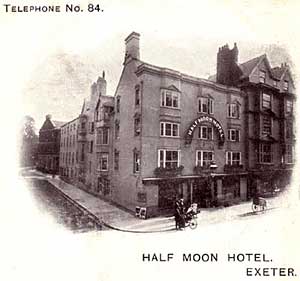 The Half
Moon Hotel, demolished in 1912.
The Half
Moon Hotel, demolished in 1912.
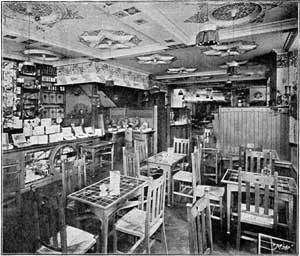 The interior of the first Deller's
Café in Cathedral Close, now Michael Caine's Abode.
The interior of the first Deller's
Café in Cathedral Close, now Michael Caine's Abode.
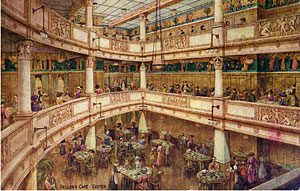 The
ornate interior of Deller's Café.
The
ornate interior of Deller's Café.
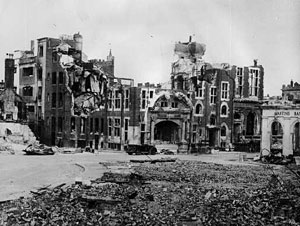 The
bombed remains of Deller's Café in the High Street. Photo
Western Times.
The
bombed remains of Deller's Café in the High Street. Photo
Western Times.
│ Top of Page │
 Join the Exeter Memories